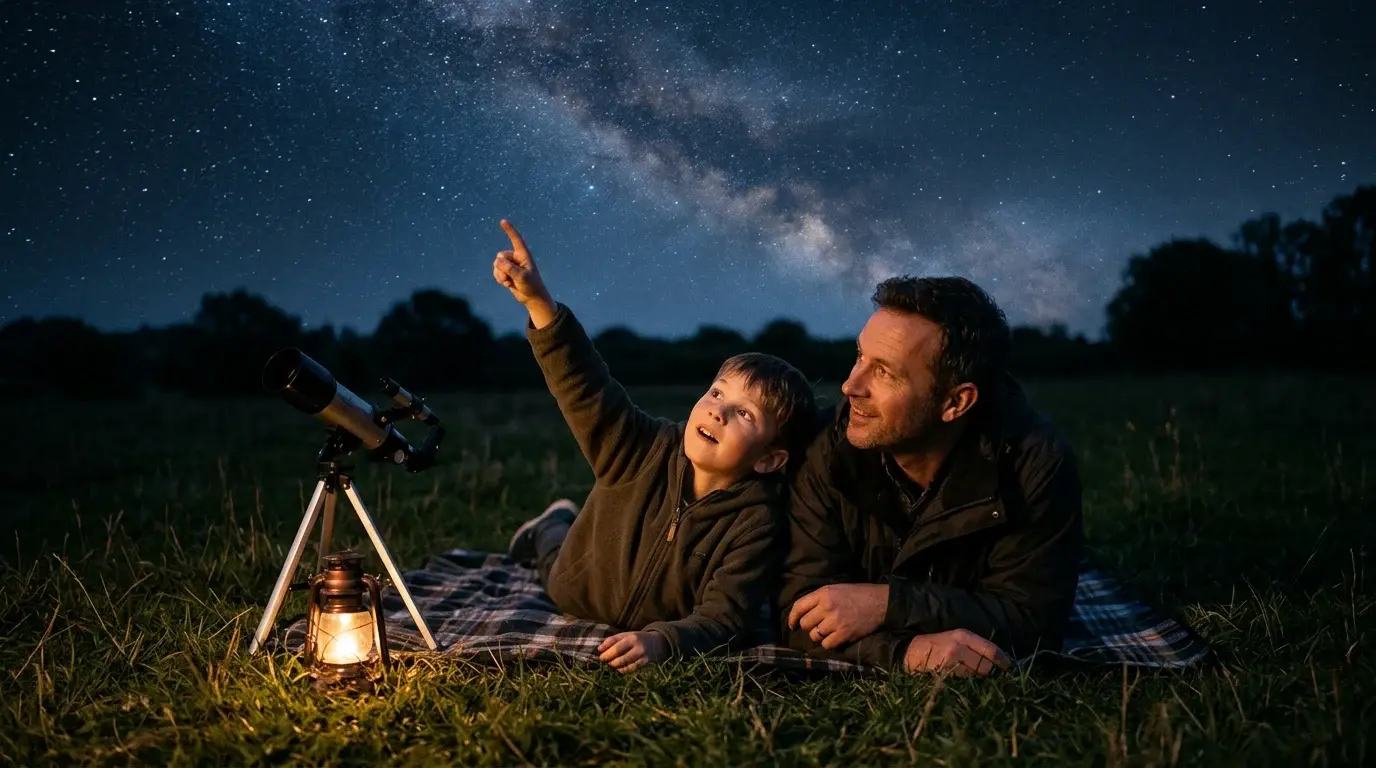
Many science fiction stories begin lying in a field at night, looking up. A father points at a speck of light and says that star might not exist any more, that what we're seeing is light that left it thousands of years ago. The boy goes quiet. A question has just been born in his head that won't let go of him for years: what if someone, out there, were looking back at us?
That question is the heart of the genre. Science fiction isn't about putting spaceships on the cover; it's about taking a "what if…?" seriously and following it all the way through. What if we could erase memories? What if Earth became uninhabitable within fifty years? What if a machine learned to lie? The great novels of the genre, from Frankenstein to the series that fill Kindle today, do exactly that: they imagine a change and show us what it does to people.
Writing science fiction is thrilling, and it has its traps. You have to invent a world that doesn't exist without losing the reader in it, decide how much science you need, explain what's necessary without turning the novel into a technical manual and, above all, never forget that readers come for the people, not the warp drives. This guide explains how to find your idea, build a consistent future, create characters who matter, present the world without stopping the story, avoid clichés, lean on AI and publish your novel on Amazon KDP.
Quick summary: A science fiction novel starts from a change to our world (a technology, a discovery, a future, a first contact) and explores its consequences for people's lives. To write it well you need a clear "what if…?" question, consistent rules that don't break halfway through the book, human characters at the centre, a way of revealing the world through everyday details rather than long explanations, and a theme that also speaks to our present. The usual length is 80,000 to 110,000 words; space opera and series tend to run longer. On Amazon KDP it pays to fine-tune the subgenre in your categories, take great care over the cover and disclose any AI-generated content.
The whole journey, in seven steps
Before getting into detail, here's the full route. Each step has its own section below.
- Find your "what if…?": the specific change to our world that sets the whole novel in motion.
- Choose the subgenre and the scale: whether your story happens on a ship, in a future city or on tomorrow's Earth.
- Follow the consequences: how that "what if…?" changes society, the economy, relationships and everyday life.
- Set the rules of your science and technology: what's possible, what isn't and what it costs.
- Put people at the centre: a protagonist with a human conflict that the future world makes harder.
- Write the draft revealing the world through details, with a world bible so nothing contradicts itself.
- Revise for logic, clichés and pace, and find science fiction readers before you publish.
What makes a story science fiction
The genre's borders have been argued over for a century, but one idea helps a lot. The critic Darko Suvin called it the novum: the new element, absent from our world, that the story presents as possible based on what we know or think we know. A ship, a virus, an artificial intelligence, a law, a future. What separates science fiction from fantasy isn't whether there's technology, but that the new element is justified by rational logic rather than magic.
That doesn't mean your novel needs equations. It means your world has to run on rules the reader can understand and believe in. If teleportation exists in your future, readers will accept the invention, but they won't accept it working differently every time the plot needs it to.
And there's a second key: science fiction almost never talks only about the future. It talks about the present seen from a distance. Dystopias speak to our political fears, stories about artificial intelligence speak to what makes us human, climate fiction speaks to what we're doing to the planet right now. If your novel has something to say about the reader's world, it will have a power no starship can give it. If you're drawn more to the magical than the scientific, fantasy may be your home, and the blog has a guide on how to write a fantasy novel.
What kind of science fiction are you writing?
The genre is huge, and each subgenre promises a different experience. Readers choose books by that promise.
| Subgenre | What it promises | Usual scale | Usual length |
|---|---|---|---|
| Hard science fiction | Rigorous, plausible science driving the plot | A mission, a discovery | 90,000 to 120,000 words |
| Space opera | Adventure, galactic empires and large-scale conflict | Planets, fleets, civilisations | 100,000 to 140,000 words |
| Dystopia | A future society gone wrong and someone who rebels | A country, a city | 70,000 to 100,000 words |
| Cyberpunk | Advanced technology, megacorporations and lives on the margins | A megacity | 80,000 to 100,000 words |
| Post-apocalyptic | Surviving after the collapse | A group, a territory | 75,000 to 100,000 words |
| Climate fiction | The human consequences of climate change | A region, a generation | 75,000 to 100,000 words |
| First contact | The encounter with a non-human intelligence | A ship, a planet, humanity | 80,000 to 110,000 words |
| Time travel | Paradoxes, second chances and consequences | A life, an era | 75,000 to 100,000 words |
Length matters more than it seems. A 140,000-word young adult dystopia will be a hard sell, and a 60,000-word space opera falls short of what it promises. If your story is big, it may not be one book but a series; more on that below.
Your "what if…?" and its consequences
The initial idea usually arrives on its own: a news story, a scientific article, a conversation, a night looking at the stars. The hard part isn't having it, but squeezing it. A good science fiction idea isn't an invention: it's an invention with consequences.
The method that works best is to ask, layer by layer, what would change in the world if your "what if…?" were real. Imagine your premise is "what if we could buy and sell memories?". Keep pulling the thread:
| Layer | Question | Possible consequences |
|---|---|---|
| Technology | How does it work and what are its limits? | Memories can be copied, but degrade every time they're transferred |
| Economy | Who wins and who loses? | The poor sell their best memories; the rich buy happy childhoods |
| Law | What's regulated and what's prosecuted? | Stealing memories is a crime; forging them, even more so |
| Everyday life | What do people do on an ordinary Tuesday? | There are second-hand memory shops, and people who no longer know what they really lived |
| Relationships | How do love, family and friendship change? | A couple discovers their first memories together were bought |
| The person | What hurts your protagonist? | She sold the memory of her mother to pay a debt and now wants it back |
Notice what happened in the last row: the abstract idea has become a story. It's no longer "a novel about memories"; it's the story of a woman who wants to recover the memory of her mother. That's the leap that turns a premise into a novel.
A practical tip: one big idea. Novels that pile teleportation, time travel, aliens and artificial intelligence into the same book tend to dilute themselves. Readers accept one strong novum and a few details that come with it; they won't accept ten at once.
How much science does your science fiction need?
It's the question that worries newcomers most, especially if they don't come from a scientific background. The answer is reassuring: it depends on the subgenre and, above all, on consistency.
In hard science fiction, science is part of the pleasure of reading. Readers want the physics, biology or engineering to be plausible, and they love it when the protagonist solves a problem with real knowledge. Research isn't optional here: read popular science, consult reliable sources and, if possible, ask someone who knows to review the technical passages.
In soft or social science fiction, science is the starting point, but what matters is people and society. You don't need to explain how the ship's engine works; you need what that engine does to make sense and not change from one chapter to the next.
In both cases the golden rule is the same: science is a rule of the game, not a wild card. Every technology needs:
- What it can do, clearly.
- What it can't do, which matters even more, because conflict is born from limits.
- What it costs: energy, money, time, health, freedom. A free technology with no side effects doesn't generate stories.
If your ship can travel anywhere instantly, there will never be tension in a journey. If it takes three years, burns fuel that's in short supply and ages the crew strangely, you have material for an entire novel. It's the same logic as a good magic system: the price is what makes the power interesting.
And a warning about the near future: if your novel takes place ten or twenty years from now, check what technology already exists today. Few things age worse than a future the present has already overtaken.
People at the centre
Science fiction has a reputation for putting ideas before characters, and sometimes it has earned it. But the novels in the genre that last are almost always very human stories: someone who loses a child in a world that has turned death into paperwork, someone who falls for the wrong person in a society that forbids it, someone who has to choose between saving humanity and saving her sister.
Some questions for building your protagonist:
- What do they want, apart from the future world? Love, recognition, forgiveness, to go home, to protect someone. Human desires don't expire.
- How does your "what if…?" complicate that desire? The novum should make things hard for them, not serve as scenery.
- What do they think of the world they live in? A character who takes their future for granted is far more believable than one who explains everything like a tour guide.
- What do they stand to lose? As in any genre, without something at stake there's no tension.
A good exercise: write your novel's conflict in two sentences without using any invented word or technical term. If you can, you have a story. If you can't, you have a world, but not yet a novel.
Revealing the world without stopping the story
This is the genre's great technical challenge. Your reader doesn't know your future, and you need them to understand it. The temptation is to explain it: a couple of pages on how the Unified Government formed, how neural implants work and why the cities float. It's called an infodump, and it's probably the most common mistake in first-time science fiction.
The alternative, which some critics call incluing, is to let the reader rebuild the world from clues that appear naturally in the action. Instead of explaining that water is rationed, the protagonist turns off the tap after ten seconds without thinking, and her son counts quietly the way they taught him at school. The reader gets it without anyone saying so, and feels the world is real.
Some techniques that work:
- The everyday before the spectacular. How people pay for coffee, how they greet each other, what counts as rude. Small details convince more than grand explanations.
- Characters who take their world for granted. Nobody explains how a microwave works while using it. Your characters shouldn't explain their inventions either.
- Explanation as conflict. If something must be explained, let it be in an argument, an awkward question or a moment when the information changes something.
- Trust the reader. Genre readers enjoy decoding the world. A little confusion at the start is fine; a lot isn't.
Invented words, in moderation
Neologisms give the future flavour, but they tire readers if there are too many. Invent only the words your world would genuinely need, make them understandable from context and don't pile them into the first pages. A useful rule: if the reader needs a glossary to understand the first chapter, you have too many words.
A consistent future: the world bible
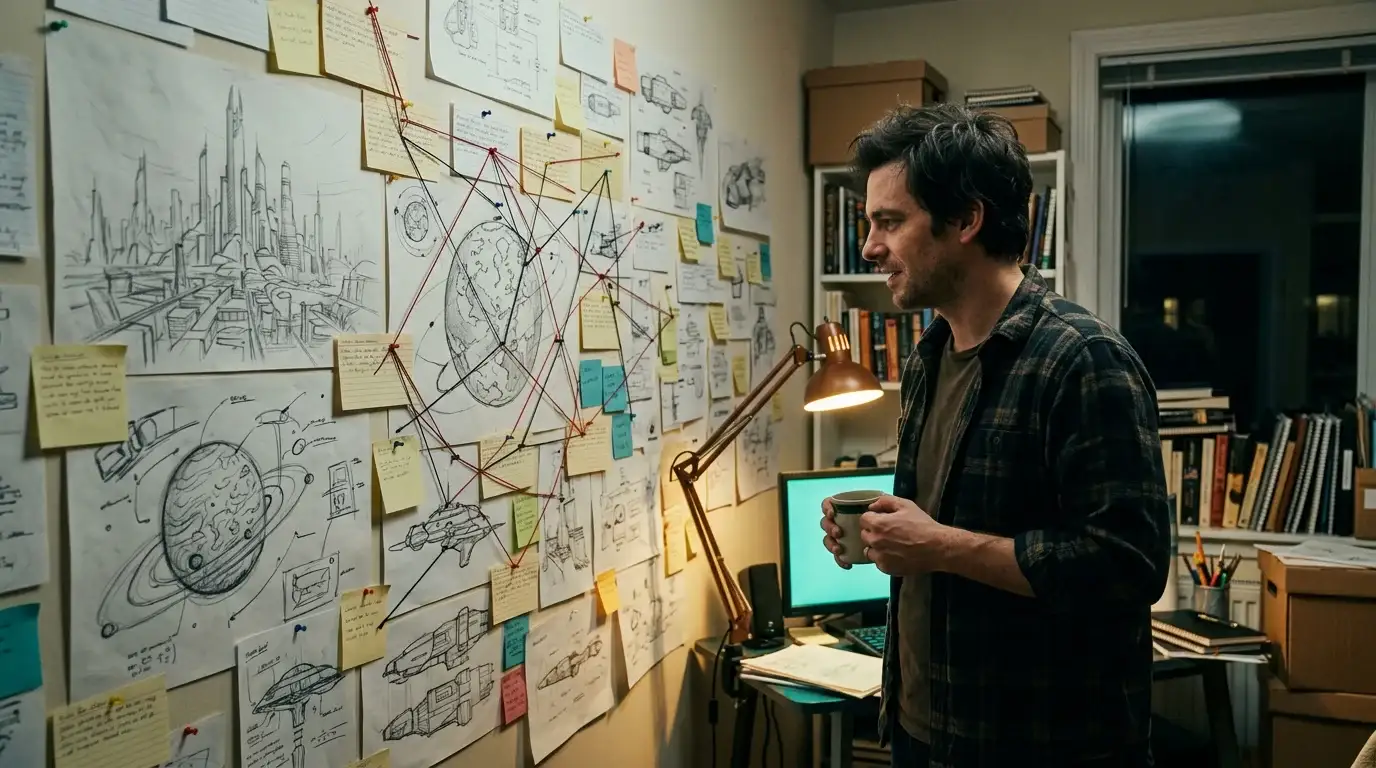
A science fiction world has lots of moving parts: technologies with their limits, dates from a future that doesn't exist, organisations, planets, distances, units, invented names and a history the reader only half knows. A single slip (a ship that takes three months in chapter four and two weeks in chapter twenty, an implant that can suddenly do something it couldn't before) is enough for an attentive reader to stop believing.
So keep these from the very start:
- The rules of each technology: what it does, what it doesn't and what it costs.
- A timeline of the future: what happened and when, even if most of it never appears in the book.
- A glossary with every invented word and its meaning.
- Character sheets, with their age, role and what they know about their world.
- Distances, travel times and scales, if your story moves between places.
In publishing, all this is called a story bible, and in science fiction it's what separates a solid future from one that leaks.
✍️ Ready to write the book this article is about?
YourNovel.app writes it with you — a complete, KDP-ready manuscript, with an AI that remembers your entire book. Free to start, no credit card.
The genre's clichés (and how to turn them around)
Science fiction has an enormous tradition, and with it a handful of commonplaces regular readers spot instantly. They're not forbidden, but if you use them, do it knowing the reader knows them.
- The artificial intelligence that rebels and wants to wipe us out. It's been told a thousand times. More interesting: an AI that wants something small and human, or is indifferent, or gets things wrong in good faith.
- The chosen one who saves the galaxy. An ordinary person facing an impossible decision works better.
- The mad scientist. Better someone reasonable whose good intentions go wrong.
- The dystopia with a cardboard tyrant. The most unsettling dystopias are the ones people accept because they're comfortable.
- The "it was all a simulation" twist. If you use it, it has to change the meaning of the story, not cancel it.
Reading widely in the genre is the best vaccine against clichés: you can't turn something around if you don't know it.
Writing science fiction with the help of AI
There's something ironic about using an artificial intelligence to write about the future, but it can be a real help if used well.
It helps most with the engineering side of the genre: checking that your technology's rules hold throughout the book, spotting contradictions in dates and distances, helping you follow the consequences of your "what if…?" with questions you hadn't thought of, or playing the sceptical reader ("if this technology exists, why doesn't anyone use it for this other thing?"). It can also help you get unstuck in a scene or write a first draft that you then rewrite in your own voice.
It helps least with what makes a science fiction novel memorable: the original idea. Language models lean towards what's most frequent in their data, and in science fiction the most frequent things are precisely the clichés: ships with grandiose names, AIs that rebel and evil corporations. Ask a generic AI for "an original science fiction idea" and it will most likely hand you something you've already read. Your "what if…?" has to come from you.
And a warning for hard science fiction: AI can invent scientific facts with complete confidence. Use it to organise and check your research, never as a source. If you want to go deeper into avoiding an artificial-sounding result, there's a complete guide on how to write a book with AI that sounds human.
One book or a series?
Science fiction, like fantasy, lends itself to series: the worlds are big and readers grow attached to them. But starting out by planning a trilogy has a risk: writing a first book that doesn't stand on its own.
Some recommendations:
- Let the first book close its main story, even if the world stays open. Readers forgive loose threads; they don't forgive an ending that isn't one.
- Write the first book in full before planning the others in detail. By the time you finish it, you'll know much more about your world.
- If you publish on Amazon, a series is a commercial advantage, because each book sells the others.
If you're considering one, the blog has a guide on how to write a series.
Revision: logic, pace and a sense of wonder
With the draft finished, we recommend three separate reads:
- Logic. Do your technology's rules hold? Are there easy solutions the characters ignore for no reason? Do the consequences of your "what if…?" show up across the whole world, or only where the plot finds them convenient?
- Pace. Look for the paragraphs that explain instead of show. Many can be cut or turned into a detail within the action.
- Emotion. Science fiction has something other genres don't: awe, what readers call the sense of wonder. Are there moments in your novel when the reader looks up from the page, astonished? If not, go looking for them.
For the full method, the blog has a guide on how to revise a complete manuscript before publishing.
Readers of the genre
The best beta readers for a science fiction novel are people who read lots of science fiction. Ask them to mark where they got lost in the world, where an explanation was too much and where something seemed impossible or inconsistent. If your novel is hard science fiction, a reader with a scientific background is worth their weight in gold.
Publishing your science fiction novel on Amazon KDP
Science fiction has some of the most voracious readers on Kindle, and it's also one of the most crowded genres. A few details make the difference:
| Element | What to do in science fiction | Common mistake |
|---|---|---|
| Categories | Fine-tune the subgenre: space opera, dystopia, cyberpunk, post-apocalyptic, military, first contact | Sticking with generic "Science Fiction", where you compete with everything |
| Keywords | Combine subgenre and hook: "dystopia bought memories", "space opera first contact" | Repeating words already in the title |
| Cover | Follow the subgenre's codes: ships and planets for space opera, neon cities for cyberpunk, clean type | A pretty cover that doesn't look like science fiction at thumbnail size |
| Description | Present the "what if…?" and the human conflict in the first lines | Explaining the world instead of the story |
| Series | Plan from the start whether the world can continue | Writing book two without having left threads |
| Kindle Unlimited | A great fit for readers who devour the genre | Not working out first how much you're paid per page read |
A few more notes:
- The usual length is 80,000 to 110,000 words. Space opera and military science fiction tend to be longer; young adult dystopias, shorter.
- Kindle Unlimited can be a good option, because readers of the genre read a lot. If you want to know how much it pays, see the guide on how much Amazon pays per page read and the KDP royalty calculator.
- Keywords and categories are decisive for being found. There's a complete guide to keywords and categories on Amazon KDP.
- AI-generated content must be disclosed when you upload the book. You'll find all the details in the guide on Amazon's AI policy.
Before uploading your manuscript, run it through a KDP manuscript checker to check margins, trim size and formatting.
How YourNovel handles it
In YourNovel.app you have two ways to write your science fiction novel, and you can combine them:
- Write it yourself, with help when you ask for it. The editor is free and unlimited, with chapters and scenes you can reorder as you like, autosave, focus mode, daily word goals and automatic versions. If you get stuck, the ideas chat knows your whole project and helps you find a way out.
- Start from what you already have. If you have a half-finished draft in Word, PDF or text, you import it and the AI organises it into chapters and prepares the story bible. On paid plans, the "Continue my novel" button proposes the missing chapters up to the length you choose, without touching yours.
For a science fiction novel, these help most:
- The story bible. YourNovel extracts characters, places and key facts from your text and keeps them to hand: what each technology can do, how long the ship takes to reach the colony or what each invented word means.
- Memory of the whole book. The AI keeps in mind everything you've already written, not just the last chapter, so a rule of your world is less likely to change halfway through.
- Analysis tools. The consistency checker looks for contradictions in characters, timeline and places, with the chapter where each appears. Pacing analysis helps you see where explanations slow the story down. They show you where to look; what's a mistake and what's a deliberate mystery is your call.
- Control over the structure. You can rename, move and delete chapters and scenes, and edit the objective of each scene that guides the AI, so the novel goes where you want it to.
- Global revision with your own instructions. For example: "flag the paragraphs that explain the technology instead of showing it" or "mark the scenes where the implant does something that contradicts its rules". The tool goes through the book section by section and proposes changes you accept one by one. Nothing changes without your approval.
- AI beta reader. A critical reading of your manuscript before you show it to anyone. A sample of the first 5,000 words is free with an account on YourNovel's AI beta reader.
- Export and cover. You download the book as PDF or Word ready for KDP, and paid plans include a cover designer with Amazon's dimensions calculated from your page count.
If you already have a science fiction novel half-written and stuck, you'll find a step-by-step method in the guide on how to finish a novel you abandoned halfway.
AI is a helper. The "what if…?", the wonder and the last line are still yours.
The most common mistakes
- The infodump. Whole pages of explanation that stop the story. Reveal the world through what the characters do.
- Too many ideas at once. One strong novum is worth more than ten inventions competing with each other.
- Technology with no limits or cost. If everything is possible, nothing is tense.
- Characters who are excuses for the world. If you remove the futuristic scenery and no human story remains, the main thing is missing.
- Rules that change to suit the plot. What a technology couldn't do in chapter three it can't do in chapter twenty without an explanation.
- Clichés left as they are. The killer AI and the galactic chosen one need something new to be interesting.
- A future the present has already overtaken. Check what exists today before inventing it.
Frequently asked questions
What's the difference between science fiction and fantasy?
Science fiction presents its extraordinary element (a technology, a future, a contact) as something possible based on rational or scientific logic. Fantasy rests on magic or the supernatural, which needs no such justification. Some works mix the two, but broadly speaking science fiction explains and fantasy enchants.
How many words should a science fiction novel have?
The usual length is 80,000 to 110,000 words. Space opera and military science fiction tend to be longer, from 100,000 to 140,000, and dystopias and young adult science fiction usually fall between 70,000 and 100,000. For a first novel, 80,000 to 100,000 words is a safe figure.
Do I need to know a lot of science to write science fiction?
Not necessarily. In hard science fiction, scientific accuracy is part of the appeal and it's worth researching thoroughly. In social or soft science fiction, it's enough for the technology to have clear, consistent rules, even if you don't explain how it works. In every case, consistency matters more than the amount of science.
How do you build a science fiction world?
Start from a specific "what if…?" and follow its consequences layer by layer: what changes in technology, the economy, the law, everyday life and relationships. Then set the rules of each technology (what it can do, what it can't and what it costs) and write everything down in a world bible to keep it consistent.
How do I avoid infodumps in science fiction?
By revealing the world through everyday details and what the characters do, instead of explaining it. Characters who take their world for granted are more believable, and the explanations that are needed work better when they're part of a conflict or a tense conversation.
Can you write science fiction with AI?
Yes, mainly as support: to check that the world's rules hold, spot contradictions, follow the consequences of an idea or get unstuck in scenes. But the original idea has to be yours, because AI tends towards the genre's clichés, and in hard science fiction it should never be used as a source of scientific facts. On Amazon KDP you must disclose AI-generated content.
Is it better to write a standalone or a series?
For a first novel, the safest choice is a book that closes its main story even if the world stays open. If it works, you can continue it. Series are a commercial advantage on Amazon, but a first book that doesn't stand on its own hurts all the others.
The question only you can ask
Every science fiction novel begins with a question nobody had asked in quite that way. It might come from a news story, a fear, a conversation or a night lying in a field looking at the stars. What turns it into a novel is taking it seriously: following its consequences, giving it rules and, above all, putting someone we care about in the middle of it.
If there's a "what if…?" going round in your head, maybe now's the time to write it. And if you want help keeping your future consistent and getting your story to the end, start writing your science fiction novel in YourNovel. The universe is big; your story fits in it too.