There is a folder on almost every writer's computer. It is called "Novel", "Final draft", "Book 2019" or something worse, like "new new FINAL". Inside there is a Word document that was last opened years ago. It has four, eight or fifteen chapters. It has a protagonist you cared about enormously, a scene you are still proud of, and one exact spot, almost always in the middle of a sentence, where everything stopped.
Nobody decides to abandon a novel. A house move happens, or a new job, a baby, a rough patch, or simply a week when you don't feel like it. That week turns into a month, and the month into three years. After that, every time you think about the book you feel a strange mix of affection and guilt. Affection for what was there. Guilt for not finishing it.
If you are reading this, you probably want to finish it. That is good news, because finishing a novel you have already started is much easier than writing one from scratch. You already have characters, a voice, a world and, above all, proof that you were capable of writing those pages. This guide explains how to find out why it stalled, how to reread it without cringing, how to decide whether to continue or rewrite, how to plan what is missing with a concrete word count, and how to keep going until the end. It also covers how AI can help you continue from where you left off without the story stopping being yours.
Quick summary: To finish a novel you abandoned halfway, first work out why it stopped (it is almost never a lack of talent; it is usually a plot, planning or time problem). Then reread the whole thing in one sitting, without editing, taking notes. Decide whether to continue from where you stopped or rewrite the beginning, make an outline of what you already have and another of what is missing, set a realistic total length (between 70,000 and 100,000 words in most genres) and a weekly pace you can actually keep. Write to the end without going back to fix things. Revision comes later. If you use AI, give it your draft so it knows the characters, the voice and the plot, and ask it to plan or write what is missing from there, not from scratch.
The whole journey, in seven steps
Before going into detail, here is the full route. Each step has its own section below.
- Work out why the novel stalled. Without that diagnosis, it is easy to get stuck at exactly the same point again.
- Reread the whole draft in one sitting, without changing anything, with a notebook beside you.
- Decide whether to continue, rewrite or start again, based on what you have just read, not on what you remembered.
- Make a reverse outline of what you already have: one line per scene, with what happens and what changes.
- Plan what is missing right up to the end, with a concrete total word count and a clear idea of the ending.
- Set a pace you can sustain and write to the last page without going back to polish.
- Revise the complete book once it is finished, and only then think about beta readers and publishing.
Why it stopped: the diagnosis almost nobody makes
The explanation we give ourselves is nearly always the same: "I didn't have time". Sometimes that is true. But if time had been the only problem, the novel would have come back as soon as things calmed down, and it didn't. More often, lack of time was the visible excuse for a problem that lived inside the book.
It is worth spending five minutes thinking about the exact moment you stopped writing. Not the date, the scene. What were you trying to write when you gave up? The answer usually says a lot.
| Why it stopped | How you recognise it | What to do |
|---|---|---|
| You didn't know what happened next | You stopped right after finishing a scene, with a feeling of "now what?" | Plan the rest before writing again: the ending and the big turning points |
| The middle went soft | You reached chapter eight or ten and everything started to feel like filler | Add a midpoint twist that changes the rules of the game |
| The story stopped interesting you | You were bored while writing, and it shows when you reread | Find what excited you at the start and put it back at the centre |
| Perfectionism | You rewrote chapter one ten times and never got past chapter three | Forbid yourself from editing until you reach the end |
| Life got in the way | You were writing well and enjoying it, then a big change arrived | Pick it up again with a small but fixed routine |
| Fear it wasn't good | You stopped just when you were about to show it to someone | Finish first, show it later |
| You got lost in your own book | You no longer remembered what happened in each chapter or who knew what | Make a reverse outline and a character sheet |
The first cause is by far the most common. Many people write their opening chapters on pure instinct, with an idea, a character and a very clear opening scene, and that works wonderfully for the first 20,000 or 30,000 words. Then instinct runs out. It isn't that you can't write: it's that you don't know where you're going. Nobody drives for long without a destination.
The second one has a name in writing manuals: the sagging middle. The beginning has the energy of discovery and the ending the energy of resolution, but in between lies a huge stretch where the story has to keep moving without anything being resolved yet. If your novel is half-finished, it is very likely you stopped right there. It happens to almost everyone.
Guilt doesn't help
One more thing before we go on. If you haven't touched your novel for years, a little voice probably pipes up every time you think about it: "if you really wanted to be a writer, you would have finished it." That voice is wrong. Plenty of published authors have abandoned novels, and quite a few books now in bookshops spent years in a drawer before they were finished. Leaving a novel doesn't disqualify you. It only means that, at that moment, something didn't fit: in the book or in your life. Now you can find out what it was.
Reread your draft without losing heart
Before writing a single new word, you have to read what you have. All of it. And here is the trap: if you read it the way a demanding editor would, you will suffer. You will see clumsy sentences, repetitions, stiff dialogue, too many adjectives and the odd chapter that makes you wince. That's normal. You have changed since you wrote it, you have read more, lived more, and your eye has improved. Seeing the flaws is a good sign: it means you can now fix them.
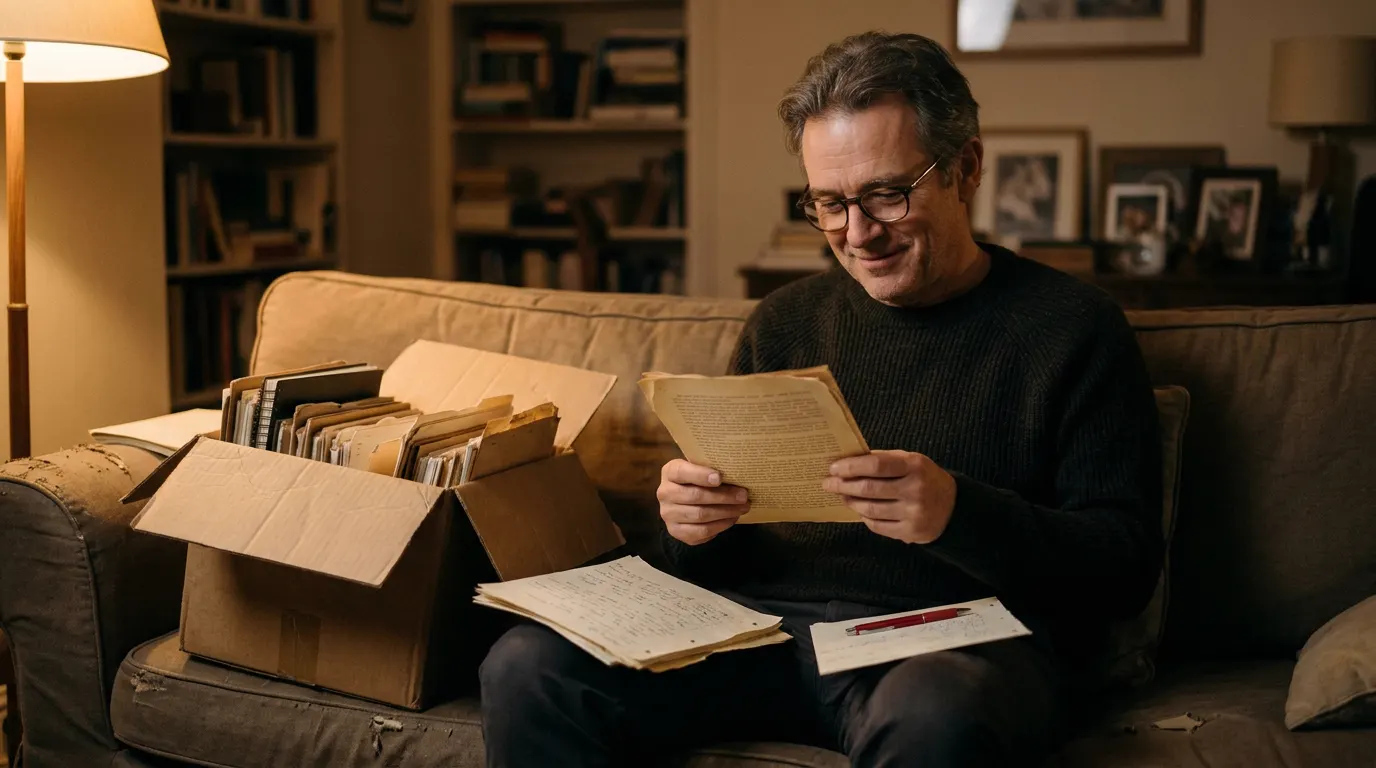
A few guidelines make rereading more useful and less painful:
- Read it in one sitting, or two at most. That way you see the novel the way a reader would, at its real pace, and you notice where the tension drops. If you read it in twenty separate bursts, you will only see sentences.
- If you can, print it or switch format. Reading it on paper, on an e-reader or even in a different font on screen helps you see it from a distance, as if someone else had written it.
- Don't fix anything while you read. Not even a comma. If you start polishing sentences, you won't see the story. Keep a notebook or a separate document beside you and note only what matters.
- Write down what works, not just what fails. The scene that still moves you, the character who has a life of their own, the line that made you smile. That is what you are going to protect.
- Mark the questions the text leaves open. Every promise you make to the reader (a secret, a mysterious object, an unresolved relationship) has to be paid off before the end. Make a list.
When you finish rereading, you should be able to answer three questions honestly. What is this story really about? What does the protagonist want, and what stops her? Do I still want to tell it? If the third answer is yes, keep reading. If it is no, keep reading too: further down you will see what to do.
Find your own voice again
There is a problem almost nobody mentions: if you left the novel years ago, your way of writing has changed. The new text may sound different from the old one, and readers notice that in the finished book. Rereading also helps you find the narrator's voice again. Pay attention to sentence length, tense, whether you narrate in first or third person, the kind of humour, and what catches your protagonist's eye. Some authors copy out the first pages of their own draft by hand before carrying on, just to get back into that music. It works better than it sounds.
Continue, rewrite or start again?
This is the big decision, and it is worth making with a cool head after rereading, not based on an idealised memory of the draft. There are three paths, and all three are legitimate.
| State of the draft | The most sensible option | Why |
|---|---|---|
| The story and the voice still convince you; only the rest is missing | Continue from where you left off | What you have already works; fixing it now would only delay the ending |
| The beginning is weak but the second half of what you wrote is good | Continue and note what needs changing at the start | Opening chapters are rewritten better once you know how the book ends |
| The story has changed a lot in your head since you wrote it | Rewrite from the beginning with what you have learned | Building on a foundation you no longer believe in will get you stuck again |
| You only like the idea, not the text | Start again, keeping the characters and the world | The text can go; the idea, the characters and what you know about them cannot |
| Two or three stories are tangled together | Separate them and pick one to finish | A novel that tries to tell everything never ends |
The rule that helps most, repeated by many writing teachers, is this: if in doubt, continue. A finished, imperfect draft is worth infinitely more than a perfect beginning. When you reach the end, you will know things about your story that you don't know now (what the theme is, who your protagonist really is, what chapter one needed to set up for the ending to work), and with that knowledge revision becomes much easier.
The only clear exception is when the underlying problem affects everything that comes after. If you decide the protagonist shouldn't be a detective but the victim's sister, or that the story isn't set in London but in a village in Cornwall, writing on top of the old version will force you to write two incompatible books. In that case, note the change, pretend the earlier chapters already reflect it and keep going. You will fix it in revision.
The reverse outline: a snapshot of what you already have
Before planning what is missing, you need to see clearly what already exists. That is what the reverse outline is for, a simple technique many editors recommend: instead of outlining before you write, you outline from what you have already written.
It is as simple as it sounds. Go through the draft chapter by chapter and, for each scene, write a single line with three things:
- What happens: the main event, in a few words. "Lucy finds the letter in the attic."
- What changes: what is different by the end of the scene. "Now she knows her mother lied to her."
- What is left open: the questions the scene leaves hanging. "Who is the man in the photo?"
If a scene changes nothing, you have learned something useful: it probably isn't needed, or it needs a reason to exist. If several scenes in a row change nothing, you have found the exact spot where the novel started to sag.
When the reverse outline is done, you will have a list of two or three pages that shows you the whole novel at a glance. It helps you remember the order of events, check what each character knows at each moment and, above all, see which questions you have to answer before the end.
If your draft is long, also make a quick character sheet: name, age, appearance, what they want, what scares them and what they know at this point in the story. And a list of places, dates and facts that cannot be contradicted later (the colour of a car, a child's age, how long it takes to get from one town to another). When you pick up a novel years later, most contradictions come from there. In publishing this is called a story bible, and keeping one up to date has never been easier.
Plan what is missing (and decide how long it will be)
With the reverse outline in front of you, it's time to design the rest of the route. You don't need to plan every scene if you don't like working that way, but you do need three things at the very least: to know how it ends, to know which big turning points lie between where you are and the ending, and to know roughly how much space you have to tell it.
Start with the ending
It may sound odd, but the most effective way to unstick a novel is to decide how it ends. You don't need the last sentence, just the final situation: does the protagonist get what she wanted? Does she get it but no longer want it? Does she lose it, but gain something more important? With the ending clear, every remaining chapter has a direction. Without it, every chapter is a gamble.
Then think about the two or three big moments that have to happen before the end. In the classic three-act structure they are usually a midpoint twist (something that completely changes what the protagonist believed or wanted), a moment when all seems lost and a climax where the main conflict is resolved. If your novel stalled in the middle, the midpoint twist is almost certainly the piece you are missing.
Put a number on the novel
Many drafts stay half-finished because they have no clear goal. "Write a novel" isn't a goal you can measure. "Reach 85,000 words" is. Knowing the total length helps you work out how many chapters are left, how long each part should be and, above all, when you will finish.
These are the usual lengths by genre. They aren't rigid rules, but they are what publishers and most readers expect:
| Genre | Usual length | For a first novel |
|---|---|---|
| Romance | 60,000 to 90,000 words | 70,000 to 80,000 |
| Mystery, suspense and crime | 70,000 to 90,000 words | 75,000 to 85,000 |
| Thriller | 80,000 to 100,000 words | 80,000 to 90,000 |
| Fantasy and science fiction | 90,000 to 120,000 words | 90,000 to 100,000 |
| Historical fiction | 90,000 to 120,000 words | 90,000 to 100,000 |
| Literary or contemporary | 70,000 to 100,000 words | 70,000 to 90,000 |
| Young adult | 50,000 to 80,000 words | 55,000 to 70,000 |
Once you have decided on the number, the maths is simple. If your draft has 28,000 words and you want to reach 85,000, you need 57,000 more. If your chapters run to about 3,000 words, that's roughly 19 more chapters. Suddenly the monster called "finishing the novel" has turned into a list of nineteen chapters, each with a purpose. That is something you can do.
If you want to dig into the structure of your particular genre, the blog has guides to writing a mystery novel, a romance novel or a fantasy novel, each with its own lengths and pitfalls.
✍️ Ready to write the book this article is about?
YourNovel.app writes it with you — a complete, KDP-ready manuscript, with an AI that remembers your entire book. Free to start, no credit card.
The middle of the book: where novels go to die
If your novel stopped somewhere between 30% and 60% of its length, you are not alone: that is the point where most manuscripts are abandoned. The beginning was written with the thrill of discovery and the ending is still far away. The middle demands something harder: keeping up the tension without resolving anything yet.
Some ideas for lifting a sagging middle:
- A twist that changes the rules. Halfway through, something has to turn the situation around: a secret revealed, an ally who betrays, a goal achieved that turns out not to be what was expected. After that twist, the protagonist can't go back.
- Raise the stakes. If in chapter three the protagonist was risking her job, by chapter twelve she should be risking something bigger: her relationship, her reputation, her life or the life of someone she loves.
- A subplot that breathes. A secondary relationship (romantic, family, friendship) gives the middle rhythm and lets the main plot rest without the book grinding to a halt.
- A clock. A deadline, a journey that has to be made before something happens, an illness that progresses. Time running out is the oldest engine in fiction and it still works.
- Cut instead of adding. Sometimes the middle sags not from a lack of events but from too many: scenes that repeat the same thing, conversations that lead nowhere. If your reverse outline shows three scenes in a row that change nothing, try merging them into one.
Get writing again: pace, rituals and the no-looking-back rule
You now know why it stopped, what you have, what's missing and how long it will be. Now comes the only thing that really finishes novels: writing. And here what matters most isn't talent or inspiration, it's consistency.
A pace you can keep even in a bad week
The most common mistake when returning to a novel is starting with a heroic plan: "I'm going to write 2,000 words a day." It lasts four days. Then a bad day comes along, you write nothing, and the guilt is back. A small goal you can meet even in a difficult week is far better.
| Pace | Approximate time per day | To write the 50,000 missing words |
|---|---|---|
| 250 words a day | 15 to 20 minutes | About 7 months |
| 500 words a day | 30 to 40 minutes | About 3.5 months |
| 1,000 words a day | Around 1 hour | About 2 months |
| 2,500 words a week (weekends only) | 2 or 3 hours on Saturday and Sunday | About 5 months |
Look at the first row for a moment: with a quarter of an hour a day, in seven months your novel is finished. That is less time than the draft has spent in the drawer.
Small rituals that help
- Write at the same time and in the same place every day, even if it's only a little. Your brain quickly learns that this corner and this hour are for writing.
- End each session in the middle of a scene, knowing what comes next. The next day you won't be facing a blank page, but a scene you already know how to continue.
- Keep a visible record: a calendar where you cross off the days, a word counter, a spreadsheet. Seeing a chain of consecutive days is surprisingly motivating.
- Tell someone. They don't need to read anything. It's enough that someone knows you are finishing your novel and asks now and then how it's going.
No going back
This is the rule that saves the most novels: until you reach the end, don't edit what came before. If in chapter twenty you realise chapter three has a mistake, write it on a list of pending changes and carry on as if it were already fixed. If you start editing, you will get trapped in the beginning again, which is exactly what happened the first time.
Ernest Hemingway is often credited with saying that the first draft of anything is rubbish (using a considerably stronger word). You don't have to agree completely, but the underlying idea is useful: the first draft exists so that there is something to revise. It doesn't have to be good. It has to be finished.
Finishing a novel with the help of AI
In recent years a possibility has appeared that didn't exist before: an artificial intelligence that helps you continue the book you started. Used well, it is a huge help for anyone who has the story in their head but can't find the time or energy to write another 60,000 words. Used badly, it produces an ending that doesn't sound like you, and any reader will notice.
The difference almost always comes down to one thing: how much the AI knows about your book. If you open a generic chat and ask it to "continue my novel", you are asking it to write the second half of a story it knows nothing about, or at best only the last chapter you pasted in. It will forget names, change your characters' personalities, contradict facts from the beginning and write in its own voice, not yours. It's like asking a stranger to finish your diary.
For AI to genuinely help you continue a novel you have started, it needs at least this:
- The complete draft, not a summary: the characters, places, events and tone you have already established.
- A story bible with everything that can't change: names, ages, relationships, rules of the world, secrets and who knows them.
- A plan for what's missing, even in broad strokes: where the story is heading and how it ends.
- A target length, so it doesn't wrap up in three chapters what needed fifteen.
- Memory of what it writes, so that chapter twenty remembers what happened in chapter twelve.
And, above all, it needs you to stay in charge. The AI can suggest how the story continues, but the ending, the twist and what happens to your protagonist are your decisions. If you want to go deeper into making the result sound natural, there is a complete guide on how to write a book with AI that sounds human.
Some writers use AI only to plan what is missing and write every word themselves. Others ask it for chapter drafts and rewrite them in their own way. Others use it only to get unstuck in a particular scene. All of these are valid. The only thing worth avoiding is publishing text you haven't read, revised and made your own.
When you finally reach the end
There is a moment many writers describe in the same way: you write the last sentence, stare at the screen and don't quite know what to feel. Relief, pride, a little emptiness. After years with a half-finished novel, completing it is one of those small victories you remember forever.

Celebrate it. Really. Print the manuscript, tell the people who matter to you, go out for dinner. And then put it away for two or three weeks without touching it. You need distance to revise it well.
Revision, now
When you return to the text, start with the list of pending changes you kept while writing. Then revise in three passes:
- First pass, the story. Does the plot work from beginning to end? Are all the questions you raised answered? Does the beginning set up the ending? This is where you rewrite those early chapters that were weak.
- Second pass, consistency. Names, dates, ages, places, who knows what at each moment. In a novel written in two different periods of your life, this is where most errors appear.
- Third pass, the sentences. Repetitions, excess adjectives, stiff dialogue, rhythm. Last, not first.
If you want a detailed method, the blog has a complete guide to revising a full manuscript before publishing. And before showing it to the world, it's well worth going through beta readers: people who read the whole book and tell you where they got bored, what they didn't understand and which character they fell for.
And then, publish
If you decide to self-publish, Amazon KDP lets you have your novel on sale as an ebook and in print within a few days, with no upfront cost. Before uploading, check the formatting with a KDP manuscript checker, choose your keywords and categories carefully and, if you used AI to write part of the text, remember that Amazon asks you to disclose AI-generated content.
How YourNovel handles it
YourNovel.app is built precisely so that a book makes it to the end, and since November 2026 it has a dedicated path for anyone who already has a novel underway.
- Upload your draft as it is. You import your manuscript as Word, PDF or plain text, and the AI reads it, organises it into chapters and scenes and prepares the story bible with your characters, places and key facts. When you upload it you can, if you like, enter the total length the book will have once finished.
- "Continue my novel". On paid plans, once the imported draft is ready, this button appears. You enter how many words the complete book should have and the AI, working from the outline of what you have already written, proposes the missing chapters needed to reach that length. The new chapters are added at the end, empty. Yours are left untouched.
- You decide who writes what's missing. You can switch on Auto-Pilot so the AI writes the pending chapters one after another, with memory of everything before, or switch to "You're writing" and write them by hand, asking for help only when you get stuck. You can change mode whenever you want, even in the middle of a chapter.
- Memory of the whole book. The AI keeps in mind everything you have already written, not just the last chapter: so it is less likely that a character changes name, forgets a secret or contradicts something that happened twenty chapters earlier.
- Tools for the middle of the book. The ideas chat knows your whole project and helps when you don't know what happens next. Pacing analysis shows you where the story drags, and the consistency checker looks for contradictions in characters, timeline and places, with the chapter where each one appears.
- Global revision with your own instructions. Once the novel is finished, you can ask, for example, "flag the passages where the tone doesn't match the first chapters". The tool goes through the book section by section and proposes changes that you accept or discard one by one. Nothing changes without your approval.
- AI beta reader and export. Before showing the book to anyone, you can request a critical reading of your manuscript; a sample of the first 5,000 words is free with an account on YourNovel's AI beta reader. And when it's ready, you download it as PDF or Word, prepared for Amazon KDP.
An honest piece of advice: when the AI proposes the missing chapters, read them calmly before going on. It's your story. If a twist doesn't convince you, change it. The plan it suggests is a starting point, not an order.
The most common mistakes when returning to a novel
- Starting again from chapter one. It's tempting to fix the beginning before carrying on, and it's the surest way never to finish.
- Picking it up without rereading it. Writing from memory leads to contradictions, characters who change personality and a voice that differs from the rest of the book.
- Not deciding on the ending. Carrying on writing "to see what happens" was probably what got you stuck the first time.
- An impossible plan. Heroic goals last a week. Small, consistent ones finish books.
- Adding instead of cutting. If the middle sags, the solution is rarely to add more scenes; it's usually to remove the ones that change nothing and add a real twist.
- Asking an AI to continue without context. Without the full draft and a story bible, the result will be a different novel stuck onto yours.
- Showing it before it's finished. Opinions halfway through tend to slow you down more than they help. Finish first; listen later.
Frequently asked questions
How do I get back into a novel I abandoned years ago?
Start by rereading the whole thing in one sitting, without editing and taking notes on what works and what doesn't. Then figure out exactly where you stopped and why, make an outline with one line per scene and decide how the story ends. With that, you can plan the missing chapters and start writing again with a small but steady routine.
Is it better to continue my draft or start over?
In most cases, continue. A finished, imperfect draft is far more useful than a perfect beginning, and the opening chapters are easier to rewrite once you know how the book ends. Starting again is only worth it if the story has changed so much in your head that writing on top of the old text would force you to write two incompatible novels.
How many words should a novel have?
It depends on the genre, but most adult novels are between 70,000 and 100,000 words. Romance and mystery usually fall between 60,000 and 90,000, fantasy and historical fiction between 90,000 and 120,000, and young adult between 50,000 and 80,000. Setting a specific figure helps you work out how many chapters you have left.
Why do I always get stuck in the middle of my novel?
Because the middle is the hardest part of any novel: the excitement of the beginning has worn off and the ending is still far away. It usually happens when there is no strong midpoint twist or when you don't know how the story ends. Deciding the ending and planning a twist that changes the rules of the game usually gets you moving again.
Can an AI continue a novel I started?
Yes, as long as it knows your complete draft and not just the last chapter: characters, voice, events and the rules of the story. Tools like YourNovel import your manuscript, prepare a story bible, propose the missing chapters up to the length you choose and write them with memory of everything before, without modifying your original chapters. Even so, it's worth revising each chapter and making it your own before publishing.
How long does it take to finish a half-written novel?
It depends on how much you have left and on your pace. At 500 words a day, around thirty or forty minutes, you can write 50,000 words in about three and a half months. At 250 words a day, in about seven months. With AI help for drafts, writing time drops a lot, although it's wise to set aside time for revision.
Do I have to fix what I already wrote before continuing?
No. Note the changes you want to make on a list and carry on writing as if they were already done. Fixing the beginning before finishing is the most common reason a novel ends up half-finished a second time. Revision comes when the draft is complete.
The novel is still there
The story you started years ago hasn't gone anywhere. It's still in that folder, with its protagonist waiting in the middle of a sentence, exactly where you left her. What has changed is you: you write better, you know more and, if you've read this far, you have a plan.
You don't need a free week or a retreat in the countryside. You need to open the file, read it all the way through, decide how it ends and write a little every day. Fifteen minutes today. Fifteen tomorrow. And one day, sooner than you think, you will write the last sentence.
If you want help along the way, upload your draft to YourNovel and let the AI help you plan the road to the end. But with or without help, finish it. That story deserves an ending, and so do you.