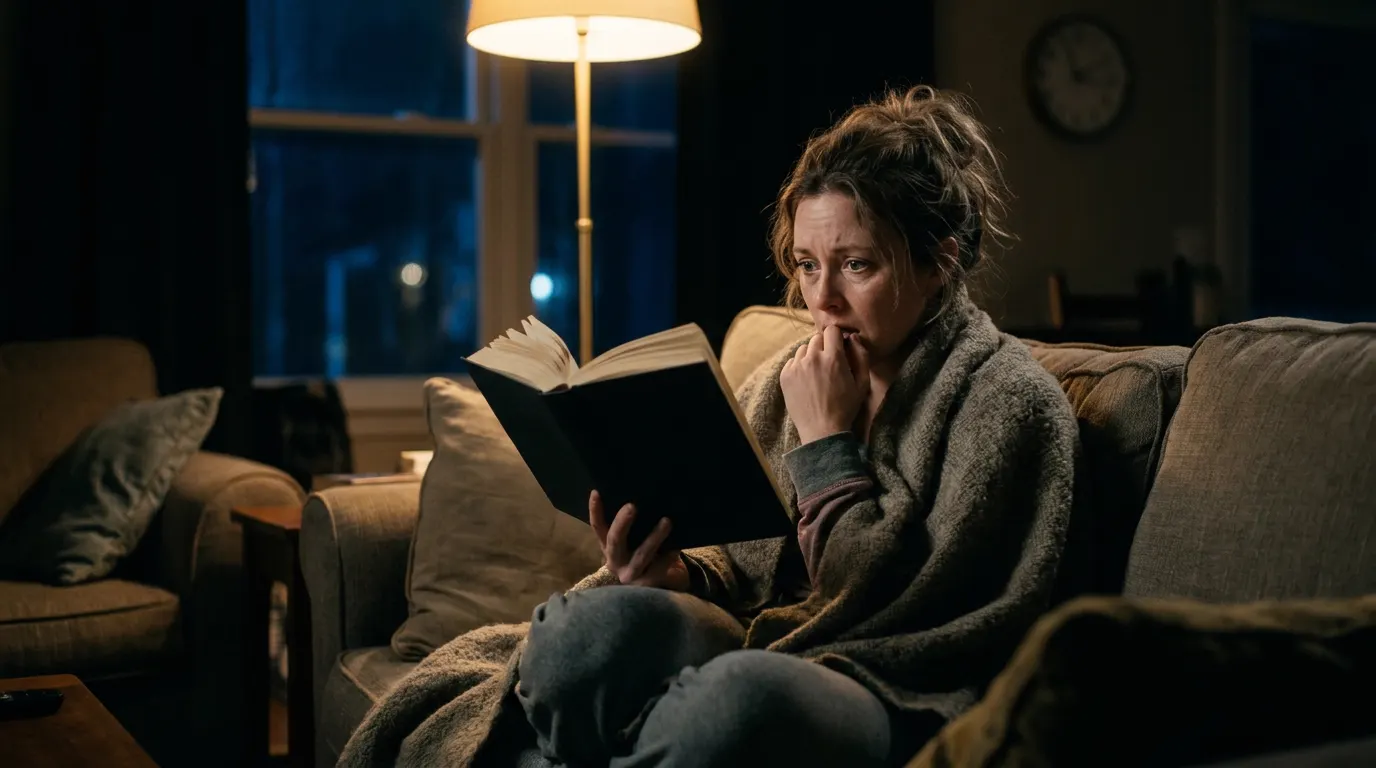
It's two in the morning. You have to get up early, you know that perfectly well, and still you tell your brain the same thing you've been telling it since midnight: "just one more chapter." The chapters are short. Each one ends with a line that won't let you switch off the light. And when you finally close the book, your heart is beating a little fast and you feel as if you've run a race without leaving the sofa.
That's what a good thriller does. And if you're here, you probably want to write one that does the same to someone else.
The thriller is one of the best-selling genres in the world, in bookshops and on Amazon, and also one of the most demanding. Its readers read a lot, read fast and have seen every trick. They know when a twist is a cheat, when the villain is made of cardboard and when a chapter is padding. This guide explains how to build a thriller that works: what sets it apart from the mystery novel, how to create real suspense, how to design an antagonist who frightens, how to handle pacing and chapter endings, how to set up twists that surprise without cheating and how to publish your novel on Amazon KDP. It also covers how to lean on AI without your story ending up like all the others.
Quick summary: A thriller is a novel in which the protagonist tries to stop something terrible from happening, against a powerful antagonist and against the clock. Its engine isn't finding out what happened, as in a mystery, but preventing what is about to happen. To write it well you need four things: something very concrete at stake, an antagonist who is a match for (or stronger than) the protagonist, a deadline that keeps getting shorter and a pace that never lets up, with short chapters that end in tension. The usual length is 80,000 to 100,000 words. Twists work when the reader, on rereading, discovers the clues were there all along. On Amazon KDP it's a very crowded genre: fine-tune the subgenre in your categories, take great care over the cover and disclose any AI-generated content.
The whole journey, in seven steps
Before getting into it, here's the full route. Each step has its own section below.
- Choose your thriller's subgenre and what it promises the reader: psychological, police procedural, espionage, medical, techno or domestic.
- Define what's at stake and what the clock is: what happens if the protagonist fails and how long she has to stop it.
- Design the antagonist before the protagonist: what they want, why, and why they're so hard to beat.
- Build the protagonist around what she stands to lose and the wound the antagonist is going to exploit.
- Plan the escalation and the twists: four or five moments when things get worse and one when everything changes meaning.
- Write the draft with a rhythm of short chapters that end in tension, alternating action and breathing space.
- Revise the logic and consistency of clues, timing and motives, then find thriller readers before publishing.
Thriller, mystery and noir: not the same thing
They're mixed up constantly in bookshops and in Amazon's categories, but it's worth being clear on the difference, because it changes how the whole book is built.
In a mystery novel, something terrible has already happened (usually a crime) and the question driving the story is who did it and why. The reader plays at guessing alongside the detective. If that's what you're writing, the blog has a complete guide on how to write a mystery novel.
In a thriller, the threat lies ahead, not behind. The question is will she make it in time? The reader often knows early on who the villain is. What they don't know is whether the protagonist will survive, whether she'll get there before the bomb goes off, whether she'll discover her husband isn't who he says he is before it's too late.
Noir puts the spotlight on society, corruption and moral ambiguity; it can have a mystery or a thriller structure, but its hallmark is the tone.
A quick way to tell what you're writing: if your story moves backwards, reconstructing what happened, it's a mystery. If it moves forwards, against the clock, it's a thriller. And many novels combine both: a crime to investigate and, at the same time, a killer who is about to strike again.
What kind of thriller are you writing?
The thriller is a large family. Each subgenre promises a different experience, and readers choose books by that promise.
| Subgenre | What it promises | Typical setting | Usual length |
|---|---|---|---|
| Psychological thriller | Doubting everything, including the narrator | A house, a couple, a mind | 70,000 to 90,000 words |
| Domestic thriller | The danger is inside the family | A suburb, a marriage | 70,000 to 90,000 words |
| Police procedural | Real investigation, step by step, against an active killer | Police stations, labs, the city | 80,000 to 100,000 words |
| Espionage and political | Conspiracies, betrayals and power games | Governments, secret services, several countries | 90,000 to 110,000 words |
| Action thriller | Chases, physical danger and a hero who never stops | Changing settings, often international | 80,000 to 100,000 words |
| Legal thriller | A trial where far more than a verdict is at stake | Courtrooms, law firms | 85,000 to 100,000 words |
| Medical or scientific thriller | A threat born in a hospital or a lab | Hospitals, research centres | 85,000 to 100,000 words |
| Techno-thriller | Technology as a weapon or a threat | Tech companies, networks, the digital world | 85,000 to 105,000 words |
Choosing a subgenre isn't about labels. It decides the type of scenes readers expect, how much research you'll need and even the tone of the cover. A psychological thriller lives on doubt and silence; an action thriller, on movement. If you mix them by accident, the reader will notice the book doesn't know what it is.
Surprise versus suspense: the lesson of the bomb
There's a classic explanation Alfred Hitchcock gave François Truffaut in their famous conversations, and it's still the best way to understand suspense. Two people are chatting calmly around a table. Suddenly a bomb goes off underneath it. The audience gets a few seconds of shock: that's surprise.
Now imagine the same scene, but the audience has already seen someone plant the bomb under the table and knows it will go off at one o'clock. There's a clock on the wall: it's a quarter to one. The two characters keep talking about football. Every trivial word becomes unbearable. The audience wants to shout at them to get out. That's suspense, and it lasts as long as the scene does.
The lesson for writers is direct: suspense comes from what the reader knows, not from what you hide from them. If you hide everything, you can only surprise them now and then. If you give them information (that the killer is in the house, that the letter has reached the wrong hands, that the husband lied about where he was that night), every later scene becomes charged with tension.
In practice, this often means showing the bomb. Chapters from the antagonist's point of view, a scene where the reader sees something the protagonist doesn't, a clue the reader understands and she doesn't. Dramatic irony works very well: the reader knows more than the character and suffers for her.
What's at stake and the ticking clock
Every thriller stands on two pillars. Take one away and the building collapses.
What's at stake
The first question you need to be able to answer in one sentence is: what happens if the protagonist fails? And the answer has to be concrete and personal. "The world will be in danger" is abstract and, curiously, moves readers very little. "Her seven-year-old daughter won't come home" moves them a lot. The best novels in the genre combine both scales: a big threat that becomes intimate, or an intimate threat that turns out to be part of something bigger.
What's at stake also has to rise throughout the book. At the start, the protagonist risks her job. By the middle, she risks her marriage and her freedom. Towards the end, she risks her life and the life of the person she loves most. If the stakes don't rise, the novel goes flat however much happens.
The clock
The second pillar is time. A thriller needs a deadline, explicit or implicit: seventy-two hours to find the girl, a trial that starts on Monday, a virus that's spreading, a killer who strikes every full moon. The clock turns every scene into a decision: if the protagonist stops to sleep, to talk to her mother or to hesitate, the reader feels it in their stomach.
A useful trick is to shorten the clock halfway through the book. The protagonist thought she had a week and suddenly discovers she only has a day. Few things speed up a novel as much.
The antagonist: the dark heart of your thriller
In many genres you start with the protagonist. In a thriller it pays to start with the antagonist. The reason is simple: a thriller is only as good as its villain. If the antagonist is weak, clumsy or predictable, the protagonist earns no credit and the reader feels no fear.
Some questions that help you build one:
- What exactly do they want? Not "to do evil", but something concrete: money, revenge, recognition, protecting a secret, saving someone in their own way.
- Why do they believe they're right? The most unsettling antagonists don't see themselves as villains. They have a logic, twisted but consistent.
- What advantage do they have over the protagonist? More power, more information, more resources, fewer scruples or intimate knowledge of her life.
- What will they do when they feel threatened? A good antagonist doesn't wait to be caught: they react, get ahead and strike back.
- Where is their crack? Something that, in the end, allows them to be beaten credibly: a mistake, an obsession, a person they care about.
Here's a very useful exercise: write the whole story from the antagonist's point of view, even if it never goes in the book. What they do each day while the protagonist investigates, what they know about her, when they start to worry. That invisible text gives weight and coherence to their appearances in the novel.
When the antagonist isn't a person
Sometimes the threat is an organisation, a system, an illness or the protagonist's own mind. It works the same way, as long as you give it a face: someone who represents it, who makes decisions and whom the protagonist can clash with. A faceless corporation isn't very frightening. The friendly executive who invites you to dinner and casually mentions the name of your children's school is terrifying.
A protagonist with something to lose
The protagonist of a thriller doesn't have to be a superhero. In fact, ordinary people pushed into extraordinary situations work better, as do competent professionals who find themselves out of their depth. What she can't be without is this:
- Something to lose. A family, a reputation, a second chance, her own sanity.
- A wound the antagonist can exploit. A past mistake, a fear, a guilt. The more personal the confrontation, the more intense it is.
- A skill that makes her capable of winning. It needn't be physical: it can be stubbornness, memory, the ability to read people or knowledge of her trade.
- Initiative. The most common mistake in first-time thrillers is a protagonist who only reacts. She has to make decisions, get things wrong and take risks.
In psychological and domestic thrillers the unreliable narrator is very common: someone who tells the story but whose version isn't entirely true, because she lies, forgets or deceives herself. It's a powerful and delicate device. It works when, on discovering the truth, the reader can look back and see there were signs. If you've simply lied to them without leaving a trace, they'll feel cheated.
Pacing: short chapters and endings that force you on
If anything sets the thriller apart from almost every other genre, it's pacing. A well-written thriller has no filler chapters, and its readers turn pages almost without noticing.
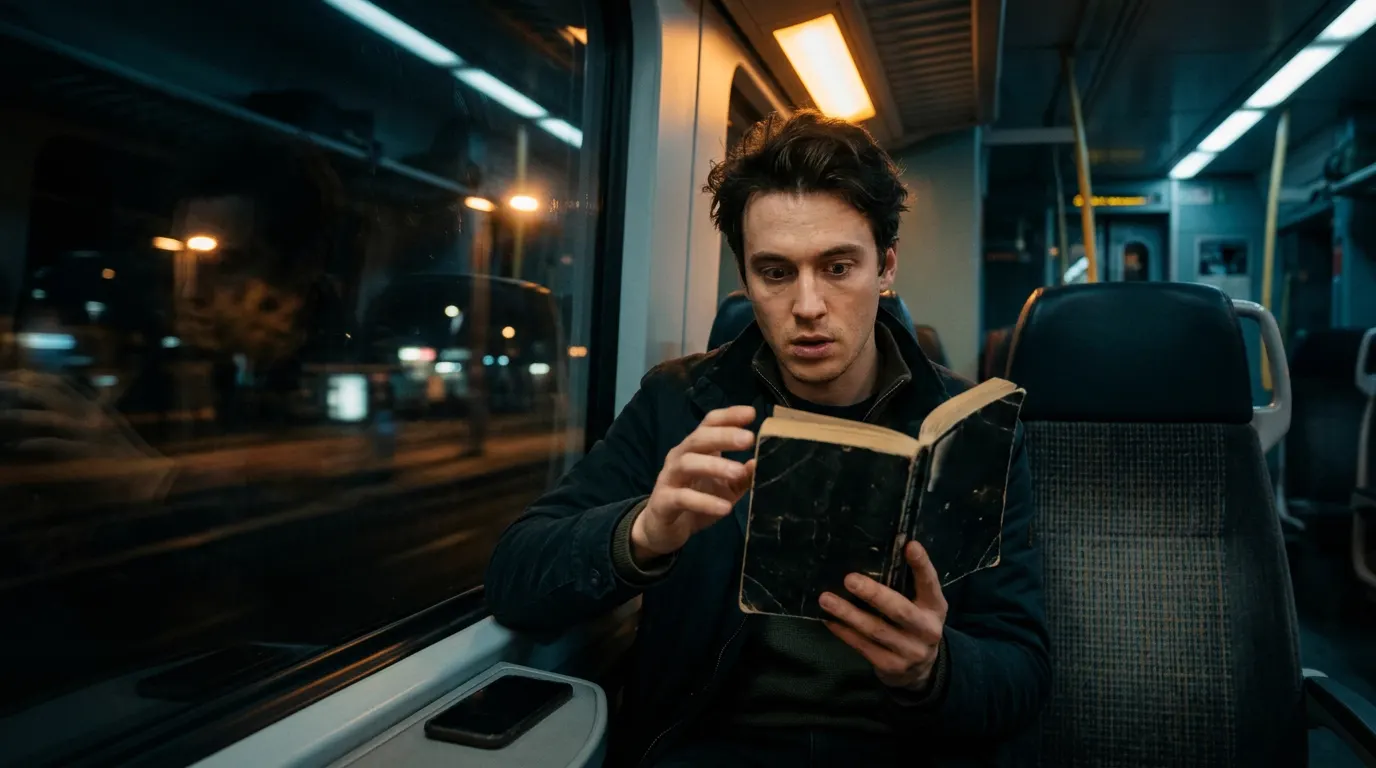
These are the main tools:
- Short chapters. Between 1,500 and 3,000 words is usual in the genre; some authors go down to 800. A short chapter gives a sense of progress and makes "just one more" an easy promise to break.
- Come in late and leave early. Start each scene as close to the conflict as possible and cut it as soon as the important thing has happened. Greetings, journeys and goodbyes are usually unnecessary.
- End in tension. You don't need an explosive cliffhanger at the end of every chapter, but you do need an open question, a new threat or a pending decision.
- Alternate points of view. Switching from the protagonist to the antagonist, or between two characters in different places, lets you cut at exactly the right moment and leave the reader wanting more.
- Ration the breathing space. A thriller that's pure action from start to finish is exhausting. Quiet scenes, where the protagonist processes what has happened and decides what to do, are necessary. What matters is that they're short and that a decision comes out of them.
These are the most common chapter endings, and when each one is useful:
| Type of ending | Example | When to use it |
|---|---|---|
| Revelation | "The blood on the knife wasn't the victim's." | When you want to change what the reader thought they knew |
| Immediate threat | "The hallway lights went out." | At moments of maximum physical tension |
| Pending decision | "She had to choose: call the police or go alone." | To draw the reader into the moral dilemma |
| Open question | "How did he know her daughter's name?" | To keep the intrigue going without violence |
| Change of point of view | Cut just as she opens the door and switch to the antagonist | To stretch the suspense one chapter more |
| Unsettling calm | "For the first time in days, she slept peacefully. She shouldn't have." | Before a big blow, so it hurts more |
One tip: don't always use the same type. If every chapter ends with someone pointing a gun, the reader stops believing it halfway through the book.
Twists that surprise without cheating
Twists are the genre's signature, and also where first-time authors go wrong most often. A good twist has two effects at once: the reader doesn't see it coming, but as soon as it happens they feel it was inevitable. If you only achieve the first, the twist seems arbitrary. If you only achieve the second, it's predictable.
Some rules that help:
- Sow before you reap. Every twist needs earlier clues, placed in plain sight but in a way the reader doesn't attach importance to at the time. A detail in a description, a line that seems like filler, a slightly odd reaction.
- Distract with something true. The best way to hide a clue is to put it in a scene that seems to be about something else, something more eye-catching.
- The twist should change the meaning of what came before, not just add information. Great twists force readers to reinterpret whole scenes.
- Don't cheat with the narrator. If a point-of-view character knows something, you can't hide it from the reader without justification. Hiding what the narrator herself is thinking, without any sign, feels like a con.
- Less is more. A thriller with one excellent twist is better than one with five mediocre ones. If everything is a twist, nothing surprises.
To check whether a twist works, try this test: list all the clues that set it up and the chapter where each appears. If you can't find at least three, the twist is limping. If all three are in the two chapters right before the twist, it's too obvious.
| A twist that works | A cheating twist |
|---|---|
| The clues were in the text and can be found on rereading | It depends on information the reader could never have had |
| It changes the meaning of earlier scenes | It just adds a surprising fact with no consequences |
| It's consistent with what we know about the character | It forces a character to act against their nature |
| It opens a new question or raises the tension | It shuts the story down abruptly with no consequences |
| The reader thinks "of course!" | The reader thinks "oh, come on" |
✍️ Ready to write the book this article is about?
YourNovel.app writes it with you — a complete, KDP-ready manuscript, with an AI that remembers your entire book. Free to start, no credit card.
Research: credibility without turning the novel into a manual
Thriller readers forgive a lot, but not police acting in impossible ways, a hacker breaking into any system in thirty seconds or someone surviving a wound that should have killed them. Research is part of the job.
That doesn't mean pouring everything you learn into the book. The rule is the same as in fantasy: know a lot, tell a little. One precise technical detail at the right moment (how a DNA sample is stored, how long a warrant takes, what shows up in a toxicology report) gives more credibility than three pages of explanation.
Some useful sources:
- Real professionals. Police officers, lawyers, doctors or journalists are often willing to answer a couple of questions if you ask them respectfully and specifically.
- Memoirs and documentaries. Books written by investigators, forensic scientists or former agents are a gold mine of everyday details that never appear in manuals.
- The rules of the country where the story takes place. Police and court procedures vary a great deal from one country to another. A thriller set in Manchester can't run on the rules of an American TV series.
And write down everything you decide in a separate document: ranks, deadlines, procedures, weapons, distances. You'll need it when, in chapter thirty, you can't remember whether the inspector had a search warrant or not.
Consistency: the thriller's silent enemy
A thriller is a precision machine. There are timetables, alibis, clues, lies and characters who know different things at different moments. A single slip (someone arriving somewhere sooner than is possible, a clue that appears twice in different forms, a character who "remembers" something they never saw) is enough for an attentive reader to stop believing the story, and in this genre readers are very attentive.
To avoid it, keep these from the very start:
- A timeline with the date and time of every important event, including those that happen off the page.
- A record of who knows what and since when. It's the most useful tool for a thriller, and the one fewest authors use.
- A list of clues and twists, with the chapter where each clue is planted and the chapter where it pays off.
- Character sheets with name, age, appearance, relationships, alibis and secrets.
In publishing, all this is called a story bible, and in a thriller it isn't a luxury: it's what stops the plot from falling apart in revision.
Writing a thriller with the help of AI
Artificial intelligence can be a very useful ally in this genre, as long as you use it where it adds value and not where it spoils things.
It helps most with the mechanical side of the thriller: checking that the timeline adds up, spotting contradictions between chapters, flagging where the pace drops, suggesting variations on a twist so you can choose the best, or playing devil's advocate ("why doesn't the protagonist call the police in chapter twelve?"). It can also help you get unstuck in a scene or write a first draft of a chapter that you then rewrite in your own voice.
It helps least with what makes a thriller unforgettable: the twist only you could have thought of, your protagonist's specific fear, the unsettling detail nobody has written before. If you ask a generic AI to "write me a thriller", you'll get the average thriller: a detective with a dark past, a serial killer with a theatrical signature and a twist any regular reader sees coming in chapter five.
And there's an important technical problem: memory. A thriller depends on every clue, every lie and every timetable holding up across hundreds of pages. A chat that only remembers the last few pages you pasted in will forget the alibi from chapter three when it writes chapter twenty-five. If you want to go deeper into avoiding an artificial-sounding result, there's a complete guide on how to write a book with AI that sounds human.
Revision: once the thriller is written
With the draft finished, the part where a thriller becomes truly good begins. We recommend three separate reads, each with its own goal:
- First read, the logic. Read the book the way a suspicious detective would. Why does each character do what they do? Could the antagonist have won sooner? Are there shortcuts the protagonist ignores for no reason? This is where plot holes show up.
- Second read, consistency. Timeline, who knows what, clues planted and paid off, names, places. With the story bible beside you.
- Third read, pace. Now, line by line. Cut everything that slows things down: long descriptions mid-action, dialogue that repeats what the reader already knows, chapters that end without tension.
If you want a detailed method, the blog has a guide on how to revise a complete manuscript before publishing.
Thriller readers, not readers in general
For this genre, the best beta readers are people who read a lot of thrillers. Ask them for something very specific: to mark the page where they guessed the twist, where they stopped reading to go to sleep (and where they couldn't stop) and the moment something felt implausible. Those three answers are worth more than any general opinion.
Publishing your thriller on Amazon KDP
The thriller is one of the best-selling genres on Kindle, and also one of the most crowded. A few details make the difference:
| Element | What to do in a thriller | Common mistake |
|---|---|---|
| Categories | Fine-tune the subgenre: psychological, police, legal, espionage, domestic | Sticking to the generic suspense category, where you compete with everything |
| Keywords | Combine subgenre, setting and hook: "psychological thriller couple secret" | Repeating words already in the title |
| Cover | Follow the subgenre's codes: big type, sober image, strong contrast | A pretty cover that doesn't look like a thriller at thumbnail size |
| Description | Open with the threat and the question, without spoiling the twist | Summarising the whole plot |
| Series | If your protagonist can return, plan for it from the first book | Writing the sequel without having left threads |
| Kindle Unlimited | A very good fit for the genre's voracious readers | Not working out first how much you're paid per page read |
A few more notes:
- The usual length in the genre is 80,000 to 100,000 words. Psychological and domestic thrillers tend to be a bit shorter; espionage thrillers, a bit longer.
- Series work especially well in police thrillers: readers who get hooked on a detective want her next case. If you're considering it, the blog has a guide on how to write a series.
- Kindle Unlimited can be a good option for a first thriller, because its readers read a lot. If you want to know how much it pays, see the guide on how much Amazon pays per page read and the KDP royalty calculator.
- AI-generated content must be disclosed when you upload the book. You'll find all the details in the guide on Amazon's AI policy.
Before uploading the manuscript, run it through a KDP manuscript checker to check margins, trim size and formatting.
How YourNovel handles it
In YourNovel.app you have two ways to write your thriller, and you can combine them:
- Write it yourself, with help when you ask for it. The editor is free and unlimited, with chapters and scenes you can reorder as you like, autosave, focus mode, daily word goals and automatic versions. If you get stuck, the ideas chat knows your whole project and helps you find a way out.
- Start from what you already have. If you have a half-finished draft in Word, PDF or text, you import it and the AI organises it into chapters and prepares the story bible. On paid plans, the "Continue my novel" button proposes the missing chapters up to the length you choose, without touching yours.
For a thriller, these help most:
- The story bible. YourNovel extracts characters, places and key facts from your text and keeps them to hand: the neighbour's alibi, the car's number plate or what the inspector knows at each moment.
- Memory of the whole book. The AI keeps in mind everything you've already written, not just the last chapter, so it's less likely to forget a clue planted in chapter three.
- Analysis tools. The consistency checker looks for contradictions in characters, timeline and places, with the chapter where each appears. Pacing analysis helps you see where the tension drops. The twist generator suggests complications when the plot stalls. They show you where to look; what's a mistake and what's a deliberate red herring is your call.
- Global revision with your own instructions. For example: "flag the chapter endings that don't end in tension" or "mark the scenes where the protagonist knows something she shouldn't know yet". The tool goes through the book section by section and proposes changes you accept one by one. Nothing changes without your approval.
- AI beta reader. A critical reading of your manuscript before you show it to anyone. A sample of the first 5,000 words is free with an account on YourNovel's AI beta reader.
- Export and cover. You download the book as PDF or Word ready for KDP, and paid plans include a cover designer with Amazon's dimensions calculated from your page count.
If you already have a thriller half-written and stuck, you'll find a step-by-step method in the guide on how to finish a novel you abandoned halfway.
AI is a helper. The twist, the fear and the last line are still yours.
The most common mistakes
- An antagonist with no weight. If the villain isn't intelligent and dangerous, there's no tension. The protagonist is only as strong as the enemy she defeats.
- A passive protagonist. Things happen to her, but she decides nothing. The reader needs to see her choose, take risks and get it wrong.
- No clock. Without urgency there's no thriller: just a novel with crimes in it.
- Explaining everything. Giving the reader every technical detail, every memory and every thought slows the story. Trust their intelligence.
- Unsown twists. A twist that doesn't rest on earlier clues looks like a cheap trick.
- Characters acting stupid so the plot can move on. "Why doesn't she call the police?" is the question that has ruined more thrillers than any other. If your protagonist doesn't call, give her a powerful reason.
- A rushed ending. After three hundred pages of tension, the climax deserves room. Wrapping everything up in two pages leaves the reader frustrated.
Frequently asked questions
What's the difference between a thriller and a mystery novel?
In a mystery, the crime has already happened and the question is who did it and why; the reader investigates alongside the detective. In a thriller, the threat is still to come and the question is whether the protagonist will manage to stop it in time. A mystery looks back; a thriller looks forward, against the clock.
How many words should a thriller have?
The usual length is 80,000 to 100,000 words. Psychological and domestic thrillers tend to be a little shorter, between 70,000 and 90,000, and espionage or political thrillers can go beyond 100,000. For a first novel, 80,000 to 90,000 words is a safe figure.
How do you create suspense in a novel?
By giving the reader information that makes them fear for the characters: that they know about a danger the protagonist can't see, that time is running out or that someone is lying. Suspense comes from anticipation, not surprise. Add rising stakes, a shrinking deadline and short chapters that end in tension.
How do you write a good plot twist?
By planting clues beforehand, in plain sight but without the reader giving them weight at the time, and by making the twist change the meaning of earlier scenes. A good twist surprises, but on rereading the reader finds the clues were there. If it depends on information the reader could never have had, it will feel like a cheat.
How long should thriller chapters be?
Chapters of 1,500 to 3,000 words are usual in the genre, and some authors make them even shorter. What matters isn't the exact figure but that each chapter has a purpose and ends with a question, a threat or a pending decision.
Can you write a thriller with AI?
Yes, mainly as support: to check the timeline and the consistency of clues, analyse pacing, suggest alternative twists or write drafts that you then rewrite. What matters is that the tool remembers the whole book and not just the last chapter, and that the twist and the voice stay yours. On Amazon KDP you must disclose AI-generated content.
How do I make sure readers can't put my book down?
With short chapters that end in tension, a ticking clock and stakes that rise throughout the book, alternating points of view to cut at the right moment and removing everything that slows the story: long descriptions, unnecessary explanations and scenes without conflict.
The page they can't put down
Writing a thriller is, deep down, an act of complicity with the reader. You promise to make them suffer a little, to make them sleep less than they should and that, in the end, the wait will have been worth it. Keeping that promise takes craft: an enemy who's a worthy match, a clock that doesn't stop, well-planted clues and a pace that doesn't forgive.
But it also takes something no technique can replace: knowing what frightens you. The best thrillers are born from a very specific fear in the person writing them. Start there. And if you want help keeping the machinery from falling apart along the way, start writing your thriller in YourNovel. Your reader is already waiting, with the light on and the alarm set to ring in four hours.