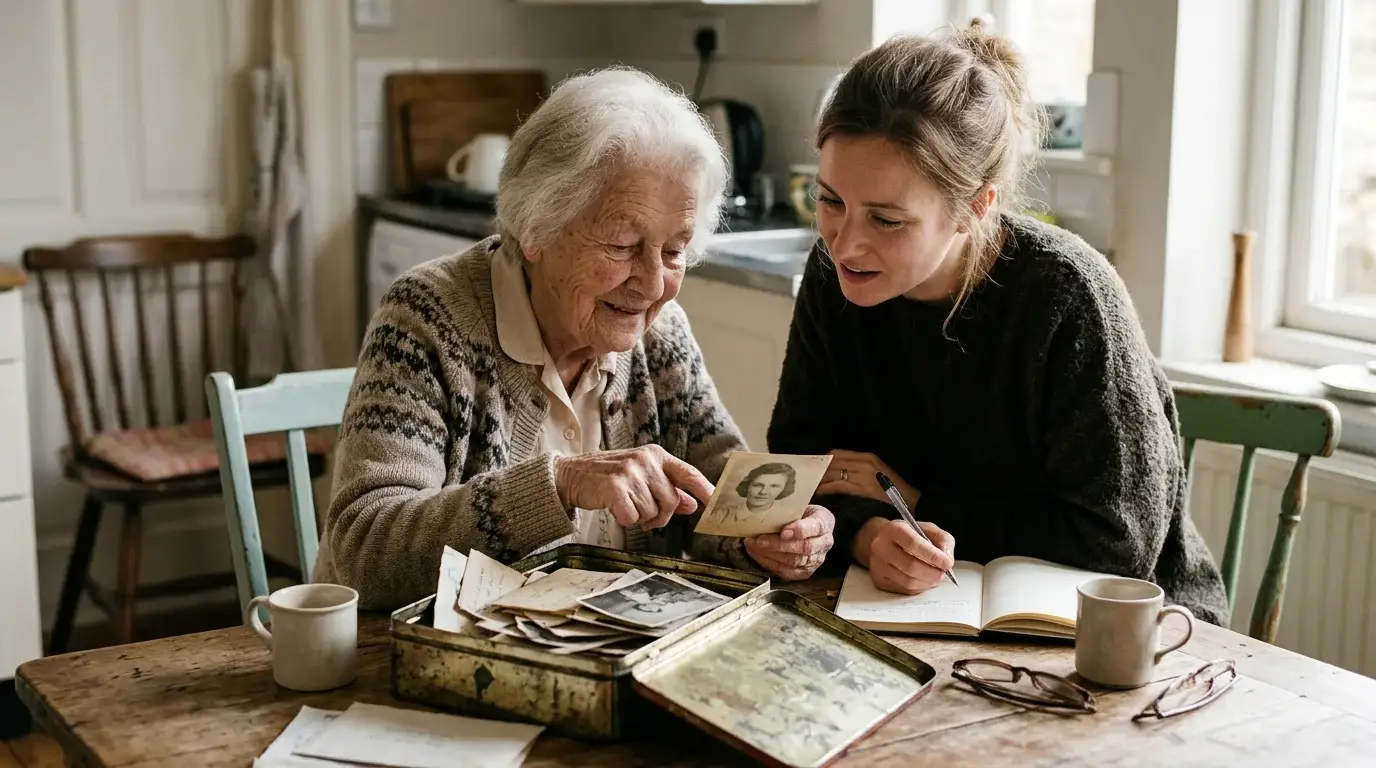
Many historical novels begin in a tin box. Inside are photographs with scalloped edges, letters folded so many times the paper has gone soft as cloth, and a face nobody in the family can name any more. Someone asks "who was this?" and Grandma, who was about to close the lid, falls silent for a moment. Then she starts to talk.
Others begin in an archive, in front of a document from 1934 that nobody has read in decades. Or at a half-worn plaque on a street corner you've walked past a thousand times. Or in a paragraph of a history book that gives a single line to something that suddenly seems to deserve three hundred pages.
Wherever it starts, writing a historical novel means giving a voice back to people who can no longer tell their own story. It's one of readers' best-loved genres, and also one of the most demanding for writers, because you have to invent without betraying. This guide explains how to choose your period and your way in, how much to research and where, how to avoid the anachronisms that give writers away, how to make your characters sound of their time without sounding like museum pieces, how to mix real and invented characters, how to lean on AI without letting it invent your history and how to publish your novel on Amazon KDP.
Quick summary: A historical novel is a work of fiction set in a past era the author didn't live through, in which the historical context genuinely shapes the plot and the characters. To write it well you need to choose a specific moment and a human point of view from which to see it, research enough for the world to feel believable (but not so much that you never start), watch out for anachronisms in objects, language and mindset, give dialogue a period flavour without imitating archaic English, and honestly separate what's historical from what's invented, usually in a note at the end. The usual length is 90,000 to 120,000 words. On Amazon KDP it pays to choose subcategories by period and place, and to disclose any AI-generated content.
The whole journey, in seven steps
Before getting into detail, here's the full route. Each step has its own section below.
- Choose the period and the event, and above all the gap: what official history doesn't tell and your novel can.
- Decide on the point of view: who lives through those events and from which corner of society they see them.
- Research in layers, from the general to the everyday, with a deadline for starting to write.
- Build a double timeline: the real historical events and, on top of them, your characters' lives.
- Find the voice of the period for the narrator and the dialogue, with an old flavour but readable today.
- Write the draft leaving markers wherever a fact is missing, without stopping to research every paragraph.
- Check for anachronisms and consistency, write the historical note and find readers who know the period.
What exactly is a historical novel?
It sounds like an obvious question, but it isn't. It's not enough for the story to take place in the past. A novel written in 1950 and set in 1950 isn't historical for the person who wrote it, even if it feels old to us today.
There's a widely used definition from the Historical Novel Society: a novel is historical if it's set at least fifty years before it was written, or written by someone who didn't live through that period and had to reconstruct it through research. The key is right there: reconstruction. Writing historical fiction is like being an archaeologist with an imagination: you dig, piece fragments together and fill the gaps with believable fiction.
There's a second condition, less formal but just as important: the period has to matter. If you could move your story to the present by swapping phones for letters and nothing changed, you don't have a historical novel, you have a novel in fancy dress. In a good historical novel the plot couldn't happen at any other time: war, the law, religion, the lack of antibiotics or what the neighbours might say shape what the characters can do and what they dare to want.
Since Walter Scott published Waverley in 1814, often considered the first modern historical novel, the genre has never stopped changing. Today the grand novel of kings and battles sits alongside the intimate story of a seamstress after the war, the mystery in a medieval monastery and the family saga that spans an entire century.
What kind of historical novel are you writing?
Each subgenre promises something different to readers and determines how much research you need and what kind of scenes they expect to find.
| Subgenre | What it promises | Example approach | Usual length |
|---|---|---|---|
| Classic or biographical historical | Living close to a real figure or a great event | A queen's court seen from the inside | 100,000 to 140,000 words |
| Intimate or literary historical | Big history seen through a small life | A village schoolteacher during the war | 80,000 to 110,000 words |
| Family saga | Several generations crossing a century of change | Three women of one family from 1900 to 1980 | 110,000 to 150,000 words |
| Historical romance | A love story the period makes difficult | An impossible love across classes in the 19th century | 80,000 to 100,000 words |
| Historical mystery | A crime and an investigation without modern science | A murder in a 14th-century abbey | 80,000 to 100,000 words |
| Historical adventure | Journeys, battles and physical danger in another era | A sea expedition in the 16th century | 90,000 to 120,000 words |
| Alternate history | What if a real event had turned out differently? | A country where a war ended the other way | 90,000 to 120,000 words |
If your novel mixes two subgenres (a mystery inside a family saga, for example), choose which one leads. Readers need to know what promise you're making. If that's what you're after, the blog has dedicated guides to writing a mystery novel or a romance novel.
Choosing your period and your way in
The question isn't just when, but from where. The same battle can be told by the general who plans it, the soldier who endures it, the mother waiting for news or the surgeon amputating legs in a field tent. Each point of view produces a completely different novel.
Some questions that help you choose:
- What obsesses you about that period? You'll need to spend years in it. If it doesn't fascinate you, it will show on the page.
- Where's the gap? The best historical novels find what history books don't tell: the women missing from the chronicles, forgotten trades, the daily lives of people who never signed documents.
- What does your protagonist stand to lose at that exact moment? The historical context must squeeze the character. An epidemic, a new law, a change of regime or a war are natural dramatic pressure.
- How much is known about that period? Well-documented eras demand more precision, because there will be expert readers. Poorly documented ones give more freedom, but demand more imagination for everyday life.
Real or invented characters
There are three options, and all of them work:
- A real protagonist. A well-known historical figure seen from the inside. It takes a lot of research and has one clear limit: you can't change what's known about their life.
- An invented protagonist among real people. The most common option. Your protagonist is fictional but crosses paths with real people and events. You're free with their life and respect what history has already fixed.
- Everything invented in a real setting. Fictional characters in a carefully reconstructed place and time. It gives the most dramatic freedom.
With real people, one common-sense rule: the more recent the period, the more care you need. Inventing the dialogue of a medieval king bothers nobody. Attributing invented deeds to someone who died a few decades ago and whose children are still alive can hurt, and even cause trouble. If in doubt, create a fictional character inspired by the real one.
Research: how much, where and when to stop
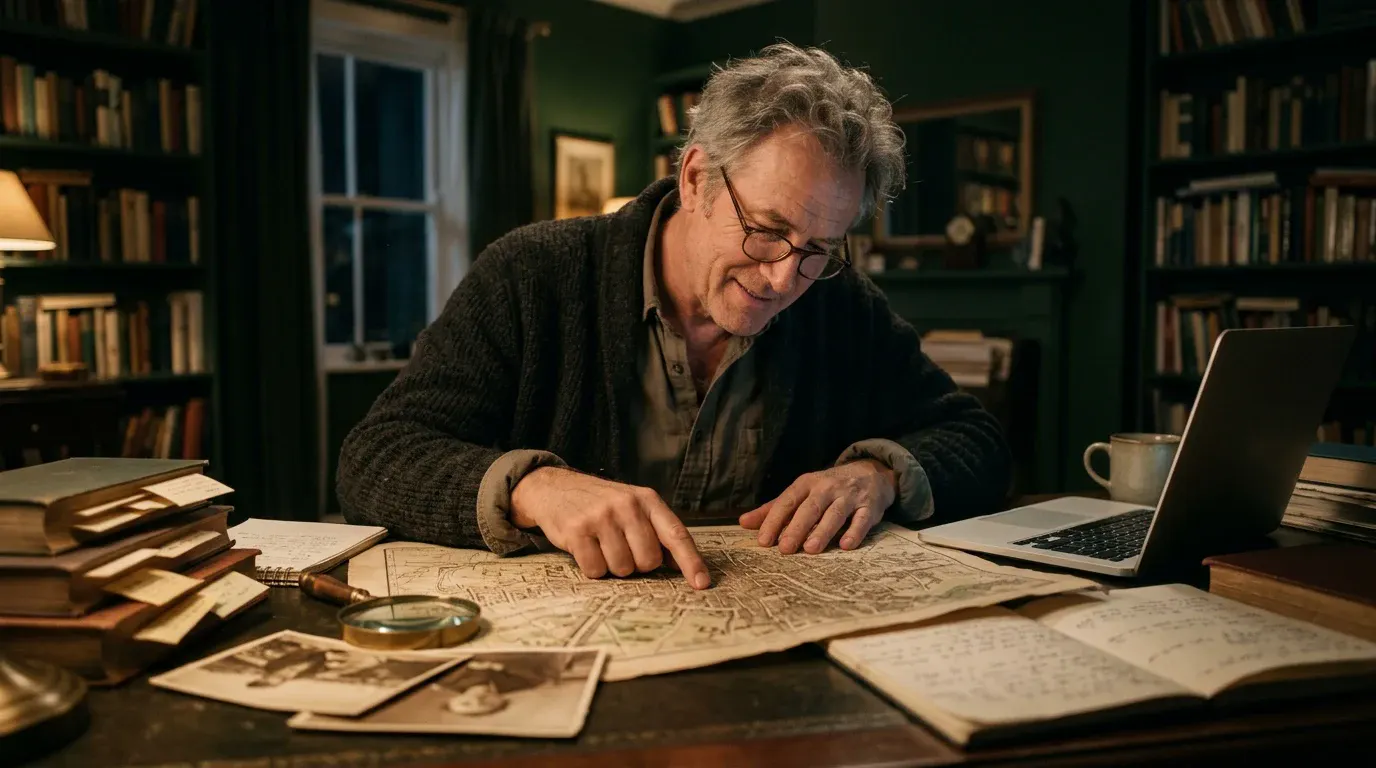
Research is the most beautiful and most dangerous part of the genre. Beautiful because you discover fascinating things every day. Dangerous because it never ends: there's always another book to read, another archive to visit, another detail to confirm. Plenty of people spend years researching a novel they never start.
The best way to avoid this is to research in layers, from the general to the specific:
- First, the big picture: what was happening in the country and the world, who was in power, what conflicts there were.
- Then everyday life: what people ate, how they dressed, what bread cost, how houses were lit, how long it took to get from one town to another.
- Finally, the specific details of your scenes, which you'll often research as you write.
And give yourself a deadline. Once you have the big picture and everyday life, start writing. Whatever's missing you'll look up scene by scene.
These are the most helpful sources, and what each one is good for:
| What you need to know | Where to look | What it's good for |
|---|---|---|
| The political and social context | General history books and monographs | Understanding the forces driving your plot |
| How people spoke and thought | Letters, diaries, memoirs and novels written at the time | Finding your characters' voice and mindset |
| Everyday life | Period newspapers, advertisements, cookbooks, catalogues | Prices, objects, customs, daily worries |
| Specific places | Old maps, street plans, photographs, period travel guides | Making sure your characters walk streets that existed |
| Official records | Historical archives, registers, censuses, minutes | Dates, names, procedures and verifiable details |
| What was never written down | Interviews with older people, folk museums | Sensations, smells, gestures, what nobody recorded |
If you're writing about Britain or the United States, the British Newspaper Archive and the Library of Congress's Chronicling America let you search newspapers from centuries ago from your own home. Old newspapers are pure gold: they don't just report the big events, but also hair tonic adverts, the price of coal and neighbours' complaints.
A word of warning: primary sources are worth more than secondary ones, but they need careful reading. A newspaper from 1936 isn't neutral, a love letter exaggerates and an official record can lie. For a novelist, those lies are material too.
The iceberg rule
As in fantasy, know a lot and tell a little. Readers don't need the full list of taxes from 1820 or an exact description of every piece of a suit of armour. They need one precise detail at the right moment (the smell of tallow candles, the cold of a church in January, the clatter of hooves on cobblestones) to feel they're there. If a scene stops to explain history, you've put the research before the character.
Anachronisms: the details that give you away
An anachronism is something that doesn't belong to the period in which it appears: an object that didn't exist yet, a word nobody used, an idea nobody would have had. Historical fiction readers spot them with astonishing precision, and a single one can break the spell of a whole chapter.
The most common fall into four types:
| Type | Example of a mistake | How to avoid it |
|---|---|---|
| Objects and technology | Potatoes in an English kitchen in 1450, or a zip on an 1880 dress | Checking when each object that matters in a scene arrived or was invented |
| Language | A 17th-century character saying "I'm so stressed" or "okay, cool" | Distrusting modern words and checking when they first appeared in a dictionary |
| Time and distance | Riding from London to Edinburgh in an afternoon | Working out journeys with the real means of the period |
| Mindset | A heroine in 1700 who thinks like a 21st-century activist for no reason | Understanding what was thinkable then and justifying characters ahead of their time |
Mindset is the hardest and most important. It's tempting to have your protagonist think like you: reject every injustice of her time, believe none of what her neighbours believed. But a character without the ideas of her time doesn't feel of her time. That doesn't mean she can't rebel. It means her rebellion must cost her something, have a believable origin and clash with what surrounds her. Characters who go against their era are fascinating precisely because the era weighs on them.
A practical trick: as you write, mark every doubtful fact with a symbol (for example, [CHECK]) and keep going. When the draft is finished, search for every marker and check them all at once. That way you don't interrupt your writing every three sentences.
The voice of the period: dialogue that sounds old without sounding like a museum
This is one of the genre's great dilemmas. If your 16th-century characters talk like Shakespeare, readers tire after ten pages. If they talk like a modern TV series, the illusion shatters. The answer lies in between: a period flavour, readable today.
Some guidelines that work:
- Avoid obvious modernisms (words, phrases or verbal tics that sound unmistakably current), but don't try to reproduce old syntax.
- Use period vocabulary for objects and trades. Calling things by their old names (the tinderbox, the corset, the stagecoach, the scrivener) adds flavour without making it harder to read.
- Take care with forms of address. Who calls whom "sir" or "madam", how a servant speaks to her mistress or a son to his father says a great deal about a society.
- Work on rhythm, not just words. Slightly longer, more ceremonious sentences for certain characters convey the period better than any archaism.
- Read texts written at the time before you write. Letters, diaries and novels from the period get you into the music of their language.
The narrator has more freedom. A third-person narrator can use careful modern English; a first-person narrator telling their life from inside the period needs more flavour.
History and fiction: how to blend them honestly
Every historical novel invents. It invents dialogue, thoughts, encounters and sometimes whole characters. That's part of the pact with the reader. What isn't part of the pact is misleading them about what's true.
Some rules most good writers in the genre follow:
- Don't change well-known major events without warning, unless you're writing alternate history. If a battle is won by the other side in your novel, readers will assume you got it wrong.
- Invent in the gaps. What isn't documented (what someone thought, what was said behind a closed door) is legitimate territory for fiction.
- If you move an event earlier or later for the sake of the plot, say so. Compressing time is common; hiding it isn't.
- Write a historical note at the end. A few pages explaining which characters existed, which events are real and what you invented. Readers of the genre love them, and they protect your credibility.
✍️ Ready to write the book this article is about?
YourNovel.app writes it with you — a complete, KDP-ready manuscript, with an AI that remembers your entire book. Free to start, no credit card.
Structure: the great event as backdrop or as engine
In a historical novel two timelines run side by side: History with a capital H, and your characters' lives. The relationship between the two shapes the structure of the book.
In some novels the great event is the backdrop: the war is there, it shapes everything, but the plot is a family's life. In others it's the engine: historical events directly drive every decision the characters make, and the novel's climax coincides with the historical one.
Either works, but it's worth deciding early, because it changes how you plan. A good tool is the double timeline: one column with the real dates and, next to it, another with what happens to your characters. That way you can see at a glance whether your protagonist is the right age in 1939, whether the pregnancy falls in the hunger winter or whether the letter could have arrived before the border closed.
And don't forget that however big the history, the novel is small: what moves readers isn't the date of a battle, but what that battle does to someone we care about.
Turning your own family's story into a novel
Many people come to historical fiction by a very particular road: they want to tell the story of their grandparents or great-grandparents. It's one of the loveliest projects there is, and it has its own challenges.
The first is deciding whether you're writing a family memoir or a novel. If you want to stay faithful to what happened and tell it as it was, you're writing memoir or family history, and the blog has a guide on how to write a memoir or autobiography. If you want the freedom to invent scenes, change names and give dramatic shape to your family's life, you're writing a novel inspired by real events.
In the second case, a few ideas:
- Record your elders while you can. Their memories, their way of speaking and their expressions are worth more than any book.
- Check memories against documents. Memory shifts dates, merges people and embellishes. Records, letters and newspapers help pin down what happened.
- Change names if there are open wounds. Family stories have secrets, and not everyone still alive wants to see them in print.
- Don't feel you have to tell everything. A novel needs a story, not a complete family tree.
The historical novel's bible
A historical novel handles a huge amount of information: real dates, characters' ages at every moment, prices, street names, titles, family ties and who knows what. If you don't write it down from the start, by chapter twenty you won't remember what the train ticket you mentioned in chapter three cost.
At a minimum, keep:
- The double timeline, with historical events and characters' lives.
- Character sheets with date of birth (to work out their age in each scene), trade, social class, beliefs and relationships.
- A period glossary: objects, trades, coins, forms of address and expressions you use, to keep them consistent.
- The source of every important fact, in case you need to check it again or cite it in the historical note.
In publishing, all this is known as a story bible, and in a historical novel it's the difference between a solid world and one full of cracks.
Writing historical fiction with the help of AI
Artificial intelligence can be a real help in this genre, but it carries a huge risk you should know about before using it: it can invent historical facts with complete confidence. A wrong date, a quotation nobody said, a person who never existed, a book that was never written. It tells you all this in the same convincing tone it uses for the truth.
So the rule is clear: AI is not a source. Never use a historical fact an AI gives you without checking it in a reliable source.
That said, there are tasks where it helps a lot:
- Organising the research you've gathered: summarising your notes, ordering dates, preparing the double timeline.
- Spotting possible anachronisms in your text for you to check: "did friction matches exist in 1790?" is a good question to then verify.
- Keeping ages, dates and relationships consistent across hundreds of pages.
- Getting you unstuck in a scene or suggesting how a character might react, which you then rewrite in your own voice.
Where it helps least is the period voice: models tend to write in neutral modern English, or to exaggerate the old-fashioned tone into parody. If you want to go deeper into avoiding an artificial-sounding result, there's a complete guide on how to write a book with AI that sounds human.
Revision: one pass just for the period
With the draft finished, revising a historical novel has a layer other genres don't. We recommend four passes:
- The story. Does the plot work? Do the characters want something and pursue it? Does the period genuinely press on them?
- Anachronisms. Find all your [CHECK] markers and verify every doubtful object, word and custom.
- Consistency. Ages, dates, distances, family ties, who knows what. With the double timeline beside you.
- Voice. Keep the period flavour constant, with no modernisms slipping in and no unnecessary archaisms.
For the full method, the blog has a guide on how to revise a complete manuscript before publishing.
A reader who knows the period
As well as your usual beta readers, in this genre it's worth its weight in gold to find someone who knows the period well: a history teacher, an enthusiast of that era or someone who lived through it as a child. Don't ask for their opinion of the plot; ask them to mark everything that jars.

Publishing your historical novel on Amazon KDP
Historical fiction has a loyal, avid readership that's very active on Kindle. A few details make the difference:
| Element | What to do in a historical novel | Common mistake |
|---|---|---|
| Categories | Choose subcategories by period, place or type (biographical, romance, mystery) | Sticking with generic "Historical Fiction", where you compete with thousands of titles |
| Keywords | Combine period, place and theme: "historical fiction wwii london women" | Using only "historical novel", which is far too broad |
| Cover | Follow the genre's codes: a figure seen from behind, period landscape or architecture, classic type | A cover that doesn't make clear when the story takes place |
| Description | Establish period and place straight away, then the character's conflict | Opening with a paragraph of historical context |
| Historical note | Include it at the end, and mention it in the description if accuracy is a selling point | Leaving it out and having readers wonder what's real |
| Series or saga | Plan from the start whether the story could continue | Writing the second book without having left threads |
A few more notes:
- The usual length is 90,000 to 120,000 words, and family sagas or big biographical novels can run longer. For a first novel, 90,000 to 100,000 is a safe figure.
- Sagas work very well in the genre. If you're considering one, the blog has a guide on how to write a series.
- Keywords are especially important, because readers of the genre search by period and place. There's a complete guide to keywords and categories on Amazon KDP.
- AI-generated content must be disclosed when you upload the book. You'll find all the details in the guide on Amazon's AI policy.
Before uploading your manuscript, run it through a KDP manuscript checker, and if you want to work out how much you'll earn per copy, use the KDP royalty calculator.
How YourNovel handles it
In YourNovel.app you have two ways to write your historical novel, and you can combine them:
- Write it yourself, with help when you ask for it. The editor is free and unlimited, with chapters and scenes you can reorder as you like, autosave, focus mode, daily word goals and automatic versions. If you get stuck, the ideas chat knows your whole project and helps you find a way out.
- Start from what you already have. If you have a half-finished draft in Word, PDF or text, you import it and the AI organises it into chapters and prepares the story bible. On paid plans, the "Continue my novel" button proposes the missing chapters up to the length you choose, without touching yours.
For a historical novel, these help most:
- The story bible. YourNovel extracts characters, places and key facts from your text and keeps them to hand: Grandma's date of birth, the name of the street where the workshop stood or the price of bread you mentioned in chapter two.
- Memory of the whole book. The AI keeps in mind everything you've already written, not just the last chapter, so it's less likely that a character changes age or trade halfway through.
- Analysis tools. The consistency checker looks for contradictions in characters, timeline and places, with the chapter where each appears. Pacing analysis helps you see where research is slowing the story down. They show you where to look; what's a mistake and what's a deliberate liberty is your call.
- Global revision with your own instructions. For example: "flag expressions that sound too modern for 1920" or "mark the paragraphs that stop to explain history". The tool goes through the book section by section and proposes changes you accept one by one. Nothing changes without your approval, and any historical facts it suggests should always be checked in a reliable source.
- AI beta reader. A critical reading of your manuscript before you show it to anyone. A sample of the first 5,000 words is free with an account on YourNovel's AI beta reader.
- Export and cover. You download the book as PDF or Word ready for KDP, and paid plans include a cover designer with Amazon's dimensions calculated from your page count.
If you already have a historical novel half-written and stuck, you'll find a step-by-step method in the guide on how to finish a novel you abandoned halfway.
AI is a helper. The research, the way of seeing and your characters' voices are still yours.
The most common mistakes
- A history lesson with dialogue. Whole paragraphs of context that stop the plot. Readers came to live in a period, not to study it.
- Researching for ever. Years of research for a novel that never starts. Set yourself a deadline.
- 21st-century characters in costume. Protagonists who think and speak like today's people with no reason to justify it.
- Cardboard archaism. Dialogue full of "prithee" and forced formulas that exhaust the reader.
- Unchecked anachronisms. A single impossible object, word or journey is enough to break trust.
- A period that doesn't matter. If the story could happen at any time, the setting is just scenery.
- Trusting AI as a source. Invented dates and quotations nobody checked.
Frequently asked questions
What counts as a historical novel?
A work of fiction set in a past era the author didn't live through and had to reconstruct through research. A widely used definition counts a novel as historical if it's set at least fifty years before it was written. The period must also genuinely shape the plot: if the story could happen today by changing only the scenery, it isn't truly historical.
How many words should a historical novel have?
The usual length is 90,000 to 120,000 words. Historical romances and mysteries tend to be a little shorter, between 80,000 and 100,000, and family sagas or big biographical novels can go beyond 140,000. For a first novel, 90,000 to 100,000 words is a safe figure.
How much research do you need to write a historical novel?
Enough to know the big picture and everyday life of the period before you start, and the rest as you write. It's worth setting yourself a deadline so you don't get trapped in research. Whatever you don't know while drafting, mark it and check it afterwards.
How do I avoid anachronisms?
By checking when the objects, words and customs that matter in your scenes first appeared, working out journeys with the real means of the period and making sure your characters think the way people could think then. A good method is to mark every doubtful fact as you write and review them all at the end, and to ask someone who knows the period to read the manuscript.
Can I use real historical figures?
Yes. It's common to mix real and invented characters, and to invent the dialogue and thoughts of historical figures. It's best not to contradict what's known about them, to take more care the more recent the period, and to explain in a historical note at the end what's real and what's fiction.
How should characters in a historical novel speak?
With a period flavour but readable today. Avoid clearly modern words and phrases, use period vocabulary for objects, trades and forms of address, and work on sentence rhythm, but don't try to reproduce the old language as it was: it would tire readers within a few pages.
Can you write a historical novel with AI?
Yes, as support for organising research, keeping dates and ages consistent, spotting possible anachronisms or getting unstuck in a scene. But AI can invent historical facts with complete confidence, so it must never be used as a source: any fact it suggests has to be checked. On Amazon KDP you must also disclose AI-generated content.
The lives nobody told
History books tell us what happened. Historical novels tell us what it felt like. That's why readers love them so much: they give back the smell, the fear, the love and the hope of people who lived before us and who, in all the ways that matter, were very much like us.
If there's a period that obsesses you, a box of photos waiting or a line in a book that haunts you, maybe now's the time to begin. Do your research, but not too much. Listen to those who can still tell. And when you want help keeping the timeline, the names and the facts from slipping away, start writing your historical novel in YourNovel. There's a life in the past waiting for someone to tell it well.